Imagine your father needs surgery. The doctor recommends admission to a private hospital, and the estimated bill is ₹1.8 lakh.
You have a family health insurance policy with a sum insured of ₹5 lakh. Naturally, you expect the insurance company to handle the hospital bill.
But at the admission counter, the staff asks for a deposit. Later, the insurance desk says the cashless request is still pending. You start wondering whether the policy will actually help.
This is where many Indian families get confused.
Cashless health insurance does not always mean that you pay absolutely nothing. It means the insurer can settle approved medical expenses directly with the hospital, subject to your policy’s terms, coverage limits and claim approval.
Knowing how this works before admission can save you from unnecessary confusion, unexpected expenses and last-minute paperwork.
In this guide, we’ll explain the complete cashless hospitalization process in India, including planned surgery, emergency admission, required documents, approval timelines, deductions, claim rejection and what to do when discharge gets delayed.
What Is Cashless Health Insurance?
Cashless health insurance is a facility where your insurance company pays the approved portion of eligible hospital expenses directly to the hospital.
Instead of paying the entire hospital bill yourself and later requesting reimbursement, the hospital coordinates with your insurer or Third-Party Administrator (TPA).
Let’s say your hospital bill is ₹1,20,000.
After reviewing the treatment and policy conditions, the insurer approves ₹1,05,000.
The insurer settles the approved amount with the hospital. You may need to pay the remaining ₹15,000, depending on the reasons for the deduction.
These amounts are only an illustration, not a typical claim outcome.
The important point is that cashless treatment reduces the need to arrange the full hospital bill upfront, but it does not remove every possible out-of-pocket expense.
How Does Cashless Hospitalization Work in India?
The process usually involves four parties:
- Patient: The person receiving treatment.
- Hospital: The healthcare provider submitting treatment and billing information.
- Insurance Company: The insurer deciding what expenses are covered.
- TPA: A Third-Party Administrator that may help coordinate claims and documentation.
Not every insurance policy uses a separate TPA. Some insurers manage claims directly.
The basic process is straightforward.
First, the hospital checks your insurance details and sends a cashless pre-authorization request. The insurer reviews the proposed treatment against your policy.
If approved, treatment proceeds under the authorized arrangement. During admission, the hospital may request an enhancement if the estimated expenses increase.
At discharge, the hospital sends the final bill and medical records for final authorization. The insurer determines the approved payment, and the patient pays any applicable balance.
One thing worth remembering: pre-authorization is not a promise that every charge in the final bill will be covered.
Who Can Get Cashless Treatment?
You may be eligible if you have an active health insurance policy that covers the treatment and the hospital can arrange the relevant cashless facility.
However, eligibility depends on several conditions.
1. Your health insurance policy must be active
Check the policy’s validity and whether premiums have been paid.
2. The treatment must be covered
Not every medical procedure is covered by every policy.
For example, a policy may have exclusions, waiting periods or specific conditions for certain treatments.
3. The hospital must support the cashless arrangement
Cashless treatment is commonly available through network hospitals.
Some insurers also offer cashless arrangements at certain non-network hospitals, subject to acceptance and approval.
Do not assume that every hospital will accept your insurance simply because you have a health insurance card.
4. Policy limits must be considered
Your claim may be affected by the available sum insured, room-rent restrictions, co-payment, deductibles or treatment-specific sub-limits.
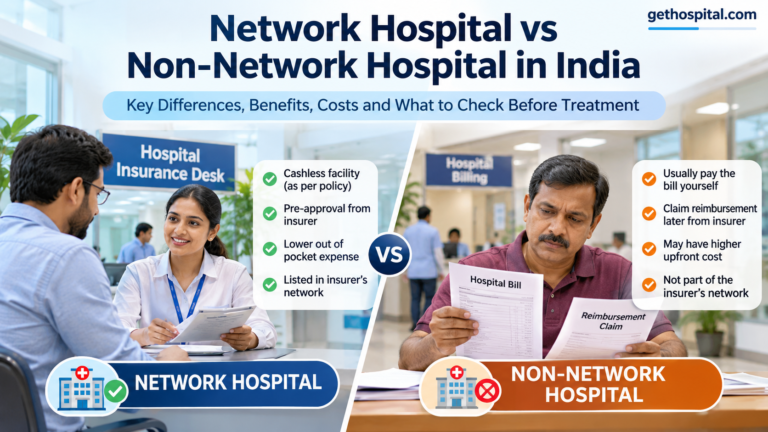
Network Hospital vs Non-Network Hospital
This is one of the most important things to check before admission.
| Network hospital | Non-network hospital |
|---|---|
| Has a cashless arrangement with the insurer or its network | May not have an existing arrangement |
| Cashless processing is generally more straightforward | Cashless may depend on a separate arrangement |
| Hospital insurance desk usually coordinates authorization | Reimbursement may be required |
| Approval still depends on policy terms | Approval and payment arrangements must be confirmed |
Suppose a hospital was included in your insurer’s network six months ago.
That does not guarantee it remains in the network today.
Before a planned admission, check the current network list on the insurer’s official website and confirm directly with the hospital insurance desk.
Ask this specific question:
“Is cashless treatment currently available for my insurance company, policy and proposed procedure?”
A general “Yes, we accept insurance” is not enough.
Documents Required for Cashless Hospitalization
Hospitals and insurers may ask for different documents depending on the treatment and policy.
Keep these ready:
- Health insurance card or policy number.
- Aadhaar or another accepted identity document.
- Doctor’s admission advice or prescription.
- Relevant diagnostic reports.
- Previous medical records, if applicable.
- Pre-authorization form.
- Employee ID or corporate insurance details, if relevant.
- Any additional documents specifically requested for the claim.
The hospital normally helps submit the pre-authorization request.
Avoid sending Aadhaar copies, medical reports or insurance documents to unofficial WhatsApp numbers or unknown agents.
Cashless Claim Process for Planned Hospitalization
Let’s say your doctor recommends gallbladder surgery next week.
Because the admission is planned, you have time to prepare.
Step 1: Check the policy
Read the coverage details for the proposed procedure.
Check waiting periods, exclusions, available sum insured and room eligibility.
Step 2: Choose and verify the hospital
Find a hospital that provides the required treatment and supports your insurer’s cashless arrangement.
Confirm this with both the insurer and hospital.
Step 3: Inform the insurer in advance
Follow the advance-intimation period mentioned in your policy.
Some policies request advance notice for planned admissions. Do not assume that one deadline applies to every insurer.
Step 4: Visit the hospital insurance desk
Provide your insurance card, identity proof and doctor’s treatment advice.
The hospital will usually prepare and send the pre-authorization request.
Step 5: Review the estimated expenses
Ask for a written estimate wherever possible.
Check whether it includes surgeon fees, anaesthesia, room charges, medicines, investigations and other likely expenses.
Step 6: Obtain authorization
The insurer reviews the submitted information and communicates its decision.
If additional documents are required, coordinate with the hospital to provide them promptly.
Step 7: Review the final bill at discharge
Before leaving, check the insurer-approved amount and your personal payment responsibility.
Ask for an itemized bill and a written explanation of significant deductions.
Cashless Claim Process During Emergency Hospitalization
Emergency hospitalization is different because treatment cannot always be planned.
Suppose a family member is admitted after an accident.
Your immediate priority should be appropriate medical care, not searching through insurance documents.
Once the patient is receiving care, a family member can contact the hospital insurance desk and inform the insurer.
The hospital may submit the emergency cashless request using the available medical details.
Follow your policy’s emergency-intimation requirements as soon as reasonably possible.
If authorization is pending, ask the hospital to explain the immediate payment arrangements and whether any deposit will be adjusted after approval.
Do not delay necessary emergency medical treatment solely to wait for insurance authorization.
How Long Does Cashless Insurance Approval Take?
This is where the IRDAI rules become particularly important.
Under IRDAI’s Master Circular on Health Insurance Business dated 29 May 2024, insurers were directed to decide on cashless authorization requests immediately and not later than one hour after receiving the request.
The circular also states that final authorization for discharge should be granted within three hours after the insurer receives the hospital’s discharge authorization request.
These are regulatory requirements, not a guarantee that every real-world claim will be processed without delays or queries.
The clock relates to the insurer receiving the relevant request. It does not necessarily start when the patient first arrives at the hospital.
If your approval is delayed, ask the insurance desk:
- Has the request actually been submitted?
- At what time was it submitted?
- Has the insurer acknowledged receipt?
- Is any document or medical clarification pending?
- What is the pre-authorization reference number?
Record these details rather than relying only on verbal updates.
Does Cashless Health Insurance Mean Zero Hospital Bill?
Not necessarily.
Even if the insurer approves cashless treatment, you may still have to pay certain expenses.
Common reasons include:
Co-payment
A co-payment means you must bear a specified portion of eligible expenses under the policy.
For example, with a 10% co-payment on ₹1,00,000 of eligible expenses, the patient’s share would be ₹10,000.
Deductible
A deductible is an amount you must pay before the policy pays eligible expenses, according to its terms.
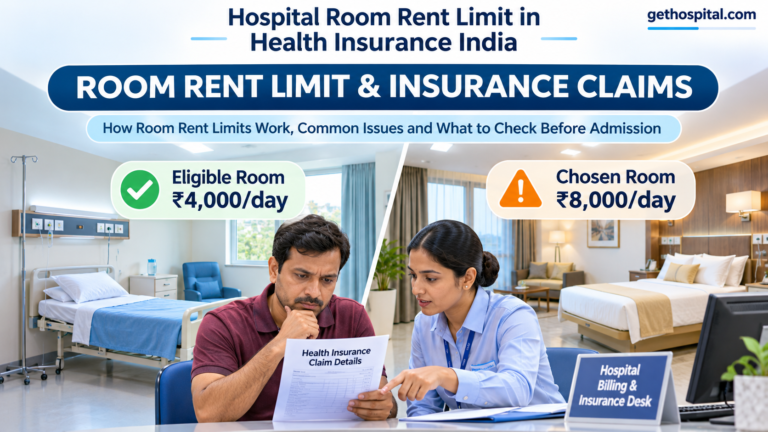
Room-rent restrictions
Some policies restrict the room category or room charges.
Choosing a room above your entitlement may affect the claim, depending on policy wording.
Treatment-specific sub-limits
Certain policies limit payment for particular procedures.
Non-payable items
Some expenses may not be covered under your policy or may fall under applicable exclusions.
Exhausted sum insured
If the available coverage is insufficient, you may need to pay the excess amount.
Example: Why a ₹2 Lakh Cashless Bill May Still Require Payment
Consider this hypothetical case:
| Particulars | Amount |
|---|---|
| Final hospital bill | ₹2,00,000 |
| Non-covered expenses | ₹8,000 |
| Eligible expenses | ₹1,92,000 |
| Co-payment at 10% | ₹19,200 |
| Insurer-approved payment | ₹1,72,800 |
| Patient’s total payment | ₹27,200 |
This is a simplified example. Actual calculations may involve other limits, deductions and policy-specific rules.
Before paying, ask the hospital for the insurer’s approval or deduction details.
A large final bill does not automatically mean the hospital has overcharged you. But it is reasonable to request a clear explanation of each amount.
What Happens If the Cashless Claim Is Rejected?
Imagine your mother is admitted to a hospital and the insurance desk tells you that the cashless request has been declined.
The first thing to understand is that rejection of a cashless request and final rejection of an insurance claim are not always the same thing.
A cashless request may fail because of missing information, a coverage dispute, an unavailable arrangement or another reason.
Ask the insurer for the specific reason in writing.
What should you do next?
First, get the written reason. Ask whether the decision is a request for additional information, a cashless authorization refusal or a final claim repudiation.
Second, review the policy. Check whether the insurer has referred to a specific exclusion, waiting period or policy condition.
Third, correct missing information. If the issue concerns incomplete medical documents, ask the hospital to provide the required clarification.
Fourth, explore reimbursement where applicable. If cashless treatment cannot be arranged, ask the insurer whether you can pay the hospital and submit a reimbursement claim later.
Finally, escalate unresolved disputes. Use the insurer’s grievance mechanism and, where appropriate, IRDAI’s official complaint channels.
Do not assume reimbursement will automatically be approved. It is still subject to the policy’s terms and claim assessment.
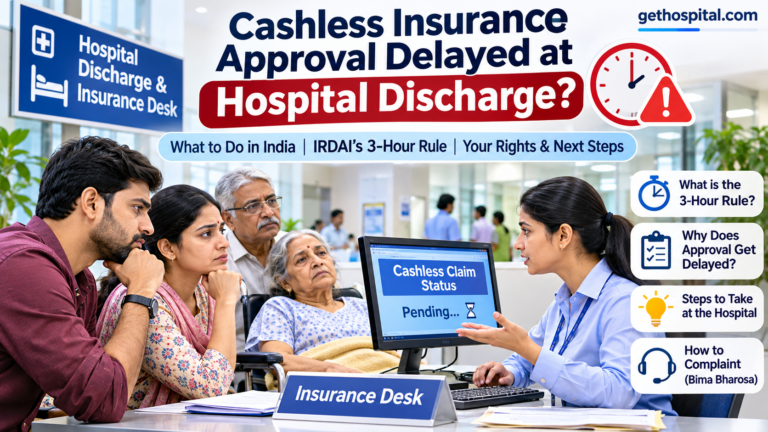
What If the Hospital Delays Discharge Because Insurance Approval Is Pending?
This is a frustrating situation for many families.
The doctor may say the patient is medically ready to go home, but the billing counter says the final insurance approval has not arrived.
IRDAI’s 2024 circular states that insurers must provide final discharge authorization within three hours of receiving the hospital’s request.
It also states that if there is a delay beyond three hours, additional amounts charged by the hospital because of that delay are to be borne by the insurer from its shareholder funds.
If this happens:
- Ask the hospital when the final authorization request was submitted.
- Obtain the claim or request reference number.
- Contact the insurer’s official claims helpline.
- Ask for the reason for the delay.
- Keep written records of additional charges.
- Escalate the matter through the insurer’s grievance channel if necessary.
Avoid arguments with medical staff who are not responsible for insurance processing. Speak with the billing team, insurance desk and insurer’s claims department.
How to Complain About a Cashless Insurance Problem in India
If your insurer does not resolve a claim-related complaint, there is a formal grievance process.
Step 1: Contact the insurer
Submit a written complaint to the insurer’s Grievance Redressal Officer.
Include your policy number, claim number, hospital name, relevant dates and supporting documents.
Keep the complaint acknowledgement.
Step 2: Escalate through IRDAI Bima Bharosa
If the insurer’s response is unsatisfactory or the complaint is not resolved within the applicable period, you can use IRDAI’s grievance mechanism.
Official portal: https://bimabharosa.irdai.gov.in/
IRDAI’s grievance guidance also provides the helpline 155255.
Step 3: Consider the Insurance Ombudsman
Eligible unresolved insurance disputes may be taken to the Insurance Ombudsman, subject to its rules and jurisdiction.
Official website: https://www.cioins.co.in/
Keep copies of your complaints, responses, policy documents, bills and medical records.
Cashless vs Reimbursement Health Insurance
| Feature | Cashless claim | Reimbursement claim |
|---|---|---|
| Initial hospital payment | Insurer settles approved expenses directly | Patient generally pays first |
| Hospital arrangement | Cashless facility required | May be used when cashless is unavailable |
| Claim documents | Coordinated through hospital and insurer | Patient submits required documents |
| Financial burden | Can reduce immediate out-of-pocket payment | May require arranging substantial funds |
| Final coverage | Subject to policy terms | Subject to policy terms |
Cashless treatment is often convenient, but reimbursement remains important when the cashless arrangement is unavailable or cannot be completed.
Seven Questions to Ask the Hospital Before Admission
Before a planned admission, ask the hospital insurance desk these questions:
- Is my insurer’s cashless facility active at this hospital?
- Is the proposed procedure eligible for cashless authorization?
- What is the estimated total treatment cost?
- Which room category is permitted under my policy?
- What deposit, if any, is required before approval?
- Which expenses might I have to pay myself?
- Who should I contact if approval or discharge gets delayed?
Write down the answers or request confirmation by email.
Even a short conversation before admission can prevent confusion at discharge.
Common Mistakes to Avoid
Assuming all network hospitals cover every treatment: Network participation does not override policy exclusions.
Ignoring the policy’s room-rent conditions: This can affect the final amount payable.
Waiting until discharge to check bills: Review major charges while treatment is ongoing when practical.
Not asking for written deductions: A verbal explanation may be difficult to challenge later.
Believing pre-authorization means full payment: The final amount depends on actual expenses and policy terms.
Sharing medical documents with unknown agents: Use official insurer and hospital channels.
Frequently Asked Questions
1. What is cashless hospitalization in India?
It is a facility where an insurer directly settles approved eligible hospital expenses with the hospital, subject to the policy’s terms.
2. Do I have to pay anything in a cashless hospital?
You may need to pay co-payments, deductibles, non-covered expenses or amounts above policy limits.
3. Can I get cashless treatment in any hospital?
Not automatically. Confirm whether your insurer and the hospital support a cashless arrangement for your treatment.
4. Is cashless treatment available in emergencies?
It may be available if the relevant policy and hospital arrangements permit it. Contact the hospital insurance desk and insurer as soon as possible.
5. How long does cashless approval take?
IRDAI’s 2024 circular specifies a maximum of one hour for the insurer’s decision after receiving the authorization request.
6. What is the three-hour discharge rule?
The IRDAI circular requires insurers to grant final discharge authorization within three hours of receiving the hospital’s request.
7. Can a hospital ask for a deposit despite cashless insurance?
A hospital may request a deposit depending on its arrangements and the status of authorization. Ask for the reason, written receipt and refund or adjustment policy.
8. Can a cashless claim be rejected?
Yes. Cashless authorization can be refused or queried for various reasons. Ask for the written explanation and available next steps.
9. Can I claim reimbursement after cashless rejection?
Possibly. Reimbursement depends on the policy terms and the insurer’s assessment. Confirm the process and deadlines.
10. What is a TPA in health insurance?
A Third-Party Administrator is an entity that may provide administrative support for insurance services and claims.
11. What is pre-authorization?
It is the insurer’s review and decision on a proposed cashless treatment request before or during hospitalization.
12. Does pre-authorization guarantee the final claim amount?
No. The final claim depends on actual treatment expenses, medical information and policy conditions.
13. Does cashless insurance cover medicines and diagnostic tests?
Coverage depends on the policy and whether the expenses are eligible and related to the covered treatment.
14. Can I choose a private room with cashless insurance?
You can ask the hospital, but room-category restrictions in your policy may affect the amount payable.
15. Where can I complain about an insurance claim delay?
Start with the insurer’s grievance team. If unresolved, use IRDAI Bima Bharosa or other eligible grievance channels.
16. Is cashless health insurance better than reimbursement?
Cashless treatment can reduce the immediate financial burden. Reimbursement may still be useful when cashless arrangements are unavailable.
Final Thoughts
Cashless health insurance can make hospitalization easier, especially when a family is already dealing with the stress of medical treatment.
But the word “cashless” should never be understood as a promise that the patient will pay nothing.
Before admission, check your policy, confirm the hospital’s cashless arrangement and ask for an estimate of expenses.
During treatment, keep track of authorization requests and significant bill changes.
At discharge, review the final approval and ask for written explanations of deductions.
A few practical checks can make the difference between a smooth hospital experience and an avoidable billing dispute.
Official Sources and Further Reading
- Insurance Regulatory and Development Authority of India: https://irdai.gov.in/
- IRDAI Bima Bharosa Grievance Portal: https://bimabharosa.irdai.gov.in/
- Insurance Ombudsman: https://www.cioins.co.in/
- Government of India, Ministry of Finance and Parliamentary Records: https://sansad.in/
Medical and Insurance Disclaimer: This guide is for general information only. It does not replace professional medical advice, your insurance policy document or guidance from your insurer. Coverage, claim requirements and hospital arrangements vary. Regulatory rules may also change. Always verify the latest terms with the insurer and relevant official authority.