Suppose your father is admitted to a private hospital in Delhi. He has a ₹5 lakh health insurance policy, and the hospital offers cashless treatment.
You choose a private room costing ₹6,000 per day because the hospital staff says it is available and comfortable.
After four days, the final bill comes to ₹1,80,000.
You expect the insurance company to cover most of it. But at discharge, the insurer approves a smaller amount, and the hospital asks you to pay a substantial balance.
When you ask why, the insurance desk mentions something called a room rent limit.
This situation can be confusing. You might wonder why the insurance company has reduced expenses other than the room charge.
The answer may involve a policy condition known as proportionate deduction.
Let’s understand how room rent limits work in Indian health insurance, when deductions can apply, and what you should check before choosing a hospital room.
What Is a Room Rent Limit in Health Insurance?
A room rent limit is a restriction in your health insurance policy on the hospital room charges or room category eligible for coverage.
Not every policy has the same limit.
Some policies specify a maximum daily amount. Others allow a particular room category, such as a single private room. Some plans do not impose a separate room rent cap, although other coverage conditions may still apply.
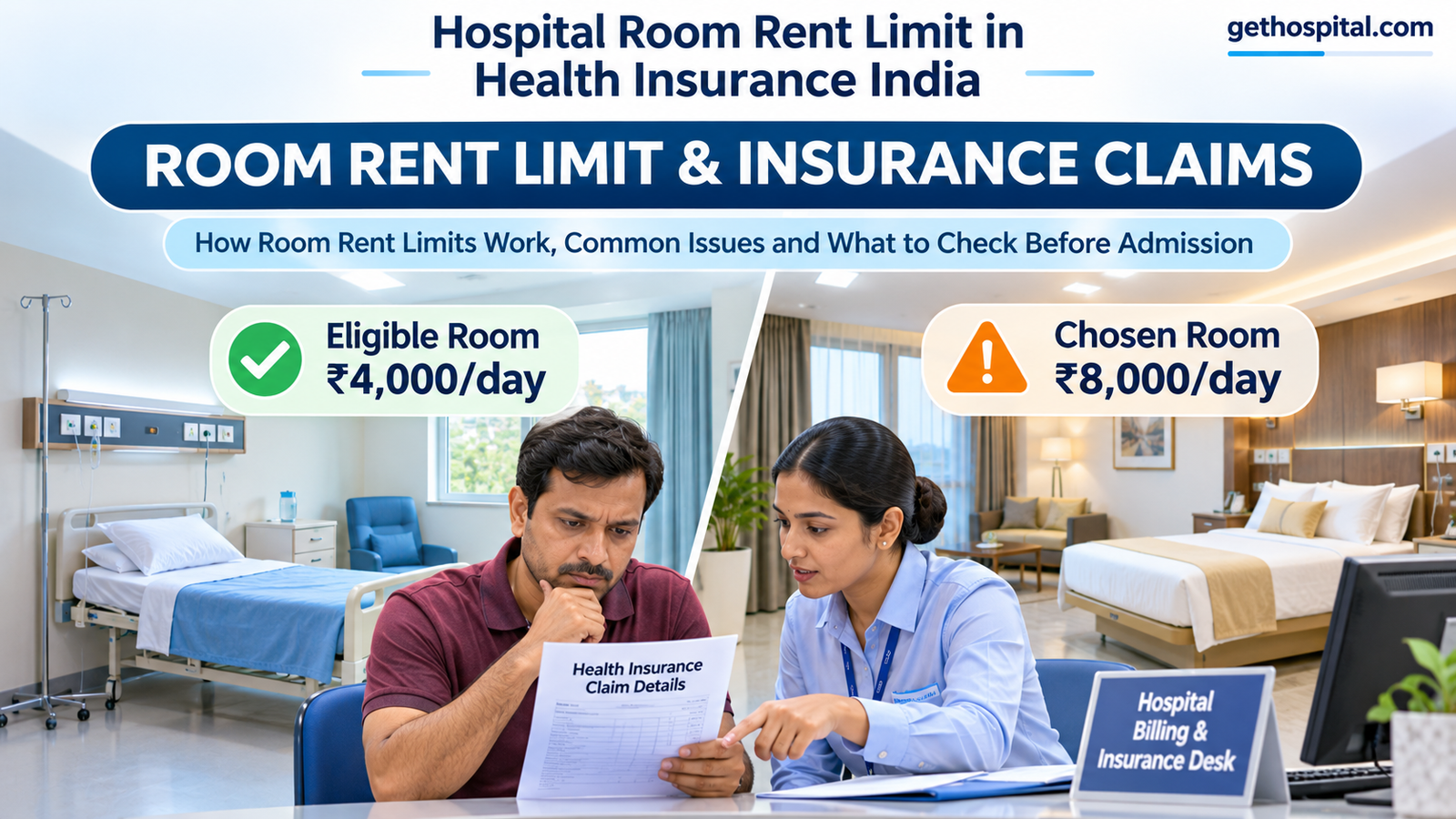
For example, imagine a policy with a ₹5 lakh sum insured and a room rent limit of 1% of the sum insured per day.
The eligible daily room rent would be:
₹5,00,000 × 1% = ₹5,000 per day
If you choose a room costing ₹4,000, you are within that monetary limit.
If you choose a room costing ₹8,000, you exceed it.
What happens next depends on your policy wording, the hospital’s billing practices and the insurer’s applicable claim rules.
Remember: A ₹5 lakh health insurance policy does not automatically mean you can select any room and expect every charge to be covered.
Types of Room Rent Limits in Indian Health Insurance
You may find different arrangements in different policies.
1. Fixed Daily Room Rent Limit
The policy specifies a fixed amount, such as ₹4,000 per day.
If the hospital charges more, the excess room rent may become your responsibility.
Additional deductions may apply to certain associated expenses if the policy permits them and the regulatory conditions are satisfied.
2. Percentage-Based Room Rent Limit
The policy links the room allowance to the sum insured.
For example:
| Sum insured | Illustrative daily limit at 1% |
|---|---|
| ₹3 lakh | ₹3,000 |
| ₹5 lakh | ₹5,000 |
| ₹10 lakh | ₹10,000 |
These are mathematical examples, not standard limits across insurance companies.
3. Room Category Restriction
Instead of specifying an amount, a policy may permit a particular room category.
For example, it might say:
Single Private Room
If you choose a suite or another category above your entitlement, the insurer may assess the claim according to the policy’s room-category provisions.
Ask the insurer how the hospital’s room classifications match the policy definition.
4. No Separate Room Rent Cap
Some health insurance plans do not impose a separate daily room rent ceiling.
This gives you more flexibility, but it does not remove all policy restrictions.
The insurer may still apply exclusions, medical necessity requirements, deductibles, co-payments, treatment limits or other applicable conditions.
Why Can Room Rent Affect More Than the Room Charge?
This is the part many policyholders miss.
Some hospitals charge different amounts for certain medical services depending on the room category.
For example, the hospital may have one rate for a doctor’s visit in a standard private room and another rate for a premium room.
An insurance policy may contain a clause that reduces specified associated medical expenses when a patient chooses a room above the eligible category.
This is known as proportionate deduction.
However, insurers cannot simply apply a percentage reduction to every item on the bill.
The applicable policy terms and IRDAI’s regulatory restrictions matter.
What Is Proportionate Deduction?
Proportionate deduction is a method used in certain health insurance policies to calculate the eligible portion of specified room-linked medical expenses.
A simplified calculation sometimes used for eligible associated expenses is:
Eligible room rent ÷ Actual room rent × Eligible associated expense
Let’s understand this with an example.
Suppose:
- Your policy permits a room costing ₹4,000 per day.
- You choose a room costing ₹8,000 per day.
- A particular room-linked medical service costs ₹20,000.
- The policy permits proportionate deduction for that service.
- The hospital uses differential billing for that service.
The illustrative ratio is:
₹4,000 ÷ ₹8,000 = 50%
So the insurer may assess ₹10,000 of that ₹20,000 charge as eligible under the proportionate-deduction provision.
The remaining ₹10,000 may become your responsibility.
This is only a simplified example. The actual method depends on the policy, eligible room category, hospital tariff and the specific expense being assessed.
It is not correct to assume that every component of a hospital bill can be reduced by 50%.
A Practical Example: How a ₹1.5 Lakh Hospital Bill May Be Affected
Imagine a patient undergoing planned surgery at a private hospital.
The policy allows a room costing ₹4,000 per day, but the patient chooses one costing ₹8,000.
The stay lasts three days.
Here is a hypothetical bill:
| Expense | Hospital bill |
|---|---|
| Room charges for three days | ₹24,000 |
| Doctor and surgeon fees | ₹45,000 |
| Nursing and other potentially room-linked services | ₹15,000 |
| Diagnostic tests | ₹12,000 |
| Medicines and consumables | ₹18,000 |
| Medical implant | ₹36,000 |
| Total | ₹1,50,000 |
Assume, purely for illustration, that the applicable policy permits proportionate deduction on the ₹60,000 of doctor, surgeon, nursing and other specified associated expenses, and the hospital has differential billing for those services.
The room ratio is 50%.
| Expense | Illustrative assessment |
|---|---|
| Eligible room rent | ₹12,000 |
| Eligible portion of specified associated expenses | ₹30,000 |
| Diagnostic tests | ₹12,000 before other policy conditions |
| Medicines and consumables | ₹18,000 before other policy conditions |
| Implant | ₹36,000 before other policy conditions |
| Illustrative eligible total | ₹1,08,000 |
In this simplified example, the difference is ₹42,000.
That does not mean the insurer will necessarily approve exactly ₹1,08,000. Other policy provisions, package rates, exclusions, deductibles and co-payments may change the final amount.
The example shows why choosing a higher room category can affect the claim beyond the room charge itself.
It also shows why you should ask for a written breakup of deductions instead of accepting a single unexplained figure.
What Does IRDAI Say About Proportionate Deductions?
The Insurance Regulatory and Development Authority of India issued guidelines on proportionate deductions in June 2020.
These guidelines place important restrictions on how insurers can apply such deductions.
Certain Expenses Must Not Be Included in Associated Medical Expenses
Under those guidelines, the definition of associated medical expenses for proportionate deduction must exclude:
- Pharmacy costs and consumables
- Implants and medical devices
- Diagnostic expenses
An insurer should not reduce these expenses merely by applying the room-rent proportionate-deduction formula.
However, this does not mean every medicine, test or implant is automatically payable. Ordinary policy exclusions, limits and coverage conditions may still apply.
Hospitals Without Differential Billing
The guidelines also restrict proportionate deductions where hospitals do not charge different rates for the relevant services according to room category.
If a hospital charges the same doctor’s fee regardless of the room occupied, the insurer cannot automatically assume that fee should be proportionately reduced under a room-category differential-billing provision.
ICU Charges
The IRDAI guidelines prohibit applying proportionate deduction to ICU charges on the basis of room-category differences.
A separate ICU coverage limit, where validly specified in the policy, is a different question and should be checked independently.
You can find the regulatory circular by searching for IRDAI/HLT/REG/CIR/151/06/2020 on the IRDAI website.
Does a Room Rent Limit Apply to ICU Charges?
Not necessarily in the same way.
Some policies specify separate limits for normal hospital rooms and ICU accommodation.
For example, a policy might provide one daily allowance for a standard room and another for ICU treatment.
But the existence of an ICU limit should not be confused with proportionate deduction on ICU charges.
If your claim contains an ICU deduction, ask the insurer:
- Is this a specific ICU sub-limit?
- Which policy clause applies?
- Is the deduction related to the actual ICU charge or to other expenses?
- How was the amount calculated?
Request a written explanation.
What If the Hospital Gives You a Higher Room Without Asking?
Suppose the hospital tells you that the room category covered by your policy is unavailable.
You are offered a more expensive room.
Before accepting it, ask the hospital insurance desk to contact your insurer.
Try to obtain written confirmation of:
- The room category available
- The room category permitted under your policy
- The reason for the upgrade
- Whether the insurer has agreed to any special arrangement
- Whether you will need to pay the difference
Do not assume that a room upgrade is free simply because the hospital initiated it.
If an emergency prevents immediate discussion, focus on obtaining necessary medical care and document the circumstances as soon as possible.
How to Check Your Room Rent Limit Before Hospital Admission
You don’t need to read every page of your policy to begin checking, but you should verify the actual wording before relying on a summary.
Step 1: Find Your Policy Schedule
Look for terms such as:
- Room Rent
- Room Category
- Room and Boarding
- Room Rent Sub-Limit
- Accommodation Eligibility
- Proportionate Deduction
Step 2: Read the Customer Information Sheet
Your insurer’s Customer Information Sheet may summarize important policy benefits and limitations.
Use it as a starting point, then check the detailed policy wording for conditions and exceptions.
Step 3: Confirm With the Insurer
Ask:
“My policy has ₹5 lakh coverage. Which room category am I eligible for, and will choosing a higher category cause proportionate deductions?”
Request the relevant policy clause.
Step 4: Check the Hospital’s Room Tariff
Ask the hospital for its current room-category price list.
Find out whether the hospital charges different rates for doctor visits, procedures or other services according to the room category.
Step 5: Ask for an Estimated Out-of-Pocket Amount
For planned hospitalization, ask the insurance desk to explain likely uncovered expenses.
The estimate may change during treatment, but it can help you make a more informed decision.
Can You Avoid Proportionate Deductions?
You can often reduce the risk of unexpected deductions by checking your eligibility before admission.
The most useful steps are:
- Choose a room within your policy’s eligible amount or category when medically appropriate and available.
- Confirm the exact room classification with the insurer.
- Ask whether the hospital follows differential billing.
- Request written clarification before upgrading.
- Review the insurer’s pre-authorization response.
- Keep copies of the room tariff, estimate and hospital communications.
If your policy has no applicable proportionate-deduction clause, do not assume the insurer can introduce one during claim settlement.
What If Your Cashless Claim Has Already Been Reduced?
Suppose you receive a final bill of ₹2,00,000 and the insurer approves ₹1,45,000.
The hospital tells you that the difference is due to room rent capping.
Do not assume the entire ₹55,000 deduction is correct without checking the details.
Ask for the Deduction Sheet
Request an itemized explanation from the insurer or TPA.
It should help you identify which expenses were reduced and why.
Check the Policy Clause
Look for the exact wording on room rent and associated medical expenses.
Confirm whether proportionate deduction is permitted under your policy.
Separate Different Types of Deductions
A claim can contain several types of adjustments:
| Deduction | What to check |
|---|---|
| Excess room rent | Eligible daily amount or room category |
| Proportionate deduction | Policy clause and hospital differential billing |
| Co-payment | Applicable percentage and policy terms |
| Deductible | Amount payable by the policyholder |
| Non-payable item | Relevant exclusion or coverage condition |
| Treatment sub-limit | Maximum benefit for the procedure |
| Package-rate adjustment | Applicable hospital-insurer arrangement |
These should not all be described vaguely as “room rent deduction.”
Ask for Reconsideration Where Appropriate
If the insurer has proportionately reduced diagnostic tests, pharmacy expenses or other excluded categories under the 2020 guidelines, ask it to explain the legal and contractual basis.
Similarly, if the hospital did not use differential billing for the expense, ask why a proportionate deduction was applied.
Provide the bill breakup, hospital tariff and policy wording where available.
Escalate an Unresolved Dispute
First raise a written grievance with your insurer.
If the issue remains unresolved, you may use IRDAI’s Bima Bharosa grievance portal and, where eligible, approach the Insurance Ombudsman.
For a related explanation of insurance disputes, explore our Health Insurance guides.
Room Rent Limit vs Co-Payment vs Deductible
These terms are often confused, but they are different.
Room rent limit: Restricts the eligible room charge or room category.
Co-payment: Requires you to bear a specified share of eligible claim expenses.
Deductible: An amount you must bear before the insurer’s payment obligation applies, according to the policy.
Proportionate deduction: A calculation affecting specified associated medical expenses when the relevant room-category conditions apply.
A policy can contain more than one of these conditions.
For example, a patient may face a room-category deduction and a separate co-payment.
That is why checking only the sum insured is not enough.
Should You Buy a Policy Without Room Rent Capping?
A policy without a separate room rent cap may offer more flexibility, particularly when private hospital rooms are expensive.
However, room rent is only one factor.
Before buying or renewing health insurance, compare:
- Coverage benefits and exclusions
- Waiting periods
- Co-payments and deductibles
- Disease-specific sub-limits
- Hospital network arrangements
- Claim procedures
- Renewal terms
- Premium affordability
- Room category restrictions
A policy without room rent capping is not automatically the best policy for every family.
If you already have insurance, check whether changing plans would affect waiting-period credits or other benefits before making a decision.
Questions to Ask the Hospital Insurance Desk
You can use these exact questions during planned admission:
“Which room category is covered under my policy?”
“What is the daily tariff for that room?”
“Does your hospital charge different doctor or procedure fees for different room categories?”
“If I select a higher room, which expenses might the insurer reduce?”
“Can you confirm the likely additional amount before admission?”
“Will you provide the insurer’s written approval and final deduction breakup?”
These questions are especially useful when a hospital offers several private-room categories.
Frequently Asked Questions
1. What does a 1% room rent limit mean?
It usually means the eligible daily room rent is calculated as 1% of the specified sum insured, subject to the actual policy wording.
For a ₹5 lakh sum insured, 1% equals ₹5,000.
2. Is room rent included in the sum insured?
Hospital room expenses may be covered within the available sum insured, subject to policy limits and conditions.
3. Will the insurer reject my entire claim if I choose a costly room?
Not necessarily. A higher room category may lead to specific deductions rather than rejection of the entire claim.
4. Does every health insurance policy have room rent capping?
No. Room rent conditions vary by policy.
5. Can a hospital room upgrade affect surgeon fees?
It may affect specified associated expenses if the policy permits proportionate deduction and the hospital follows differential billing for those services.
6. Can an insurer proportionately deduct medicine costs?
IRDAI’s 2020 guidelines exclude pharmacy and consumables from the associated medical expenses used for proportionate deductions. Other valid policy conditions may still affect coverage.
7. Can diagnostic test costs be proportionately reduced?
The 2020 guidelines exclude diagnostic expenses from proportionate deduction under the room-rent associated-expense mechanism.
8. Are implants protected from proportionate deduction?
Implants and medical devices are excluded from that specific mechanism. Their coverage remains subject to the policy.
9. Is ICU room rent treated differently?
ICU coverage may have separate policy conditions. IRDAI prohibits proportionate deduction for ICU charges based on room categories.
10. What if the eligible room is unavailable?
Ask the hospital and insurer about the available alternatives and request written clarification of any extra cost.
11. Does cashless approval remove the room rent limit?
No. Cashless approval does not automatically remove policy limits or exclusions.
12. Can I change to a lower-priced room during hospitalization?
Ask the treating team and hospital administration whether a medically appropriate room change is possible. Confirm how the insurer will assess expenses incurred in each room category.
13. Does a single private room mean any private room?
Not necessarily. Hospitals may classify rooms differently. Confirm your eligible category with the insurer.
14. Can a group health insurance policy have room rent limits?
Yes. Employer-provided group policies may contain room-category limits or other cost-sharing conditions.
15. What if the insurer deducts more than expected?
Ask for the calculation, relevant policy clause and expense-wise deduction statement. Raise a grievance if the explanation appears inconsistent.
16. Can room rent limits change at renewal?
Policy terms may change subject to applicable rules and contractual requirements. Review renewal documents and any insurer communication carefully.
17. Does choosing a network hospital remove proportionate deductions?
No. Network status and room-rent eligibility are separate issues.
Read our Health Insurance section to understand network hospitals, cashless claims and reimbursement.
18. Where can I find the official rules?
Visit the IRDAI website and search for its June 2020 circular on proportionate deductions. Also check the policy wording applicable to your claim.
Final Thoughts
A room rent limit may look like a small condition in your health insurance policy, but it can make a noticeable difference to your final hospital bill.
The biggest mistake is assuming that a ₹5 lakh or ₹10 lakh policy automatically covers any room you choose.
Before planned hospitalization, check the eligible room category, the hospital tariff and whether your policy contains a proportionate-deduction clause.
And if you receive an unexpected deduction, ask for the calculation rather than accepting a general explanation.
A few minutes spent checking your room entitlement can help you avoid an unpleasant surprise at discharge.
Disclaimer: This article provides general educational information for patients and policyholders in India. It is not personalized insurance, legal or medical advice. Coverage and claim decisions depend on the applicable policy, hospital billing practices and current regulatory requirements. Confirm details with your insurer and healthcare provider.