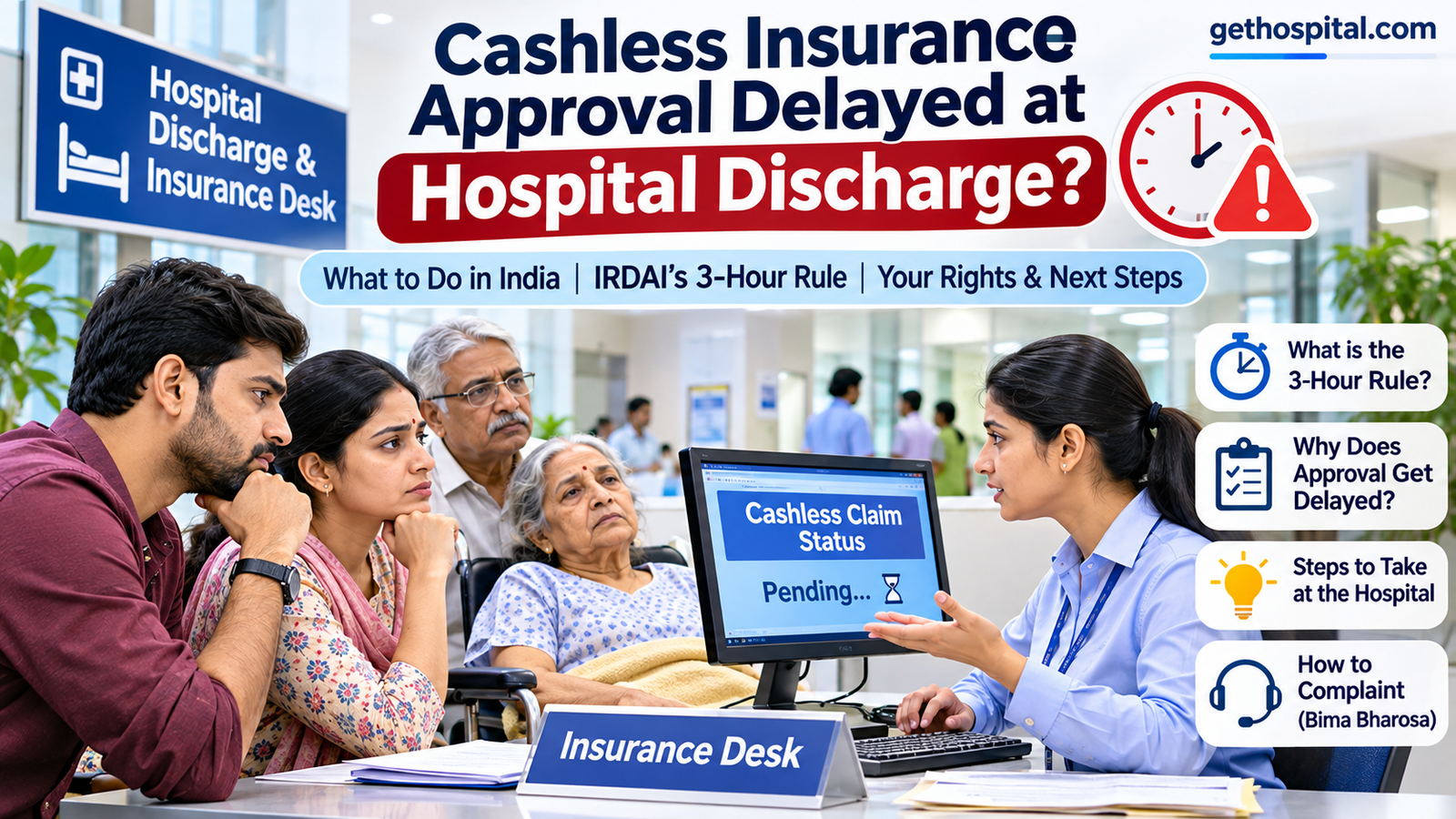
Imagine your mother has been admitted to a private hospital for four days. Her treatment is complete, and the doctor says she can go home.
The hospital prepares the final bill and sends it to the health insurance company for cashless approval.
You pack her belongings, arrange transport and wait near the billing counter.
One hour passes. Then two hours.
When you ask the insurance desk, the answer is the same: “Sir, insurance approval is still pending.”
By evening, your mother is tired, the family is frustrated, and nobody can tell you exactly when the discharge will happen.
If you’ve experienced something similar, you know how stressful it can be.
But there are important questions to ask before accepting an indefinite delay.
India’s insurance regulator, IRDAI, has prescribed a three-hour timeline for final cashless discharge authorization after the insurer receives the hospital’s request.
Let’s understand what that means, why discharge approval gets delayed and what you can do while you’re still at the hospital.
What Is Cashless Discharge Approval?
When you use cashless health insurance, the insurer pays the eligible portion of your hospital expenses directly to the hospital under the applicable arrangement.
This does not necessarily mean your entire hospital bill is covered.
At the time of discharge, the hospital prepares the final bill and sends the required information to the insurer or Third Party Administrator (TPA).
The insurer reviews the claim and communicates the amount it has authorized for cashless settlement.
The hospital then calculates the balance, if any, that you must pay.
For example, suppose the final hospital bill is ₹1,40,000.
The insurer approves ₹1,18,000.
The remaining ₹22,000 may include policy exclusions, co-payments, deductibles or other expenses not approved for cashless settlement.
These amounts are hypothetical.
The actual claim depends on your policy terms and the hospital’s billing details.
Why Does Cashless Approval Get Delayed at Discharge?
Not every delay happens for the same reason.
Sometimes the hospital has not sent the final documents. Sometimes the insurer needs clarification. In other cases, the claim is waiting for review.
Understanding where the process is stuck helps you contact the right person.
1. The Hospital Has Not Submitted the Final Bill
The doctor may have approved discharge, but the billing department may still be preparing the final invoice.
There may be pending pharmacy bills, laboratory charges, procedure records or consultant fees.
Until the hospital submits the discharge authorization request, the insurer may not have received the information needed to make its final decision.
What to ask: “Has the final discharge authorization request actually been submitted to the insurer?”
2. The Insurer Has Asked for Additional Information
The insurer may request clarification about the treatment, final diagnosis, medical records or particular expenses.
Ask the hospital insurance desk exactly what information is pending and who is responsible for providing it.
3. The Final Bill Is Different From the Original Estimate
Let’s say the hospital initially estimated treatment expenses of ₹90,000.
During hospitalization, the patient required additional tests and stayed for another two days.
The final bill becomes ₹1,35,000.
The insurer may need to review the additional expenses before final settlement.
An increased bill does not automatically mean the claim will be rejected, but the insurer may need relevant supporting information.
4. There Is a Room Rent or Policy Limit Issue
The patient may have selected a room category above the policy’s entitlement.
Other possible issues include co-payments, deductibles, treatment sub-limits or excluded expenses.
These can affect the amount approved for cashless settlement.
5. The Hospital and Insurer Have a Communication Problem
Sometimes the hospital says it has submitted everything, while the insurer says documents are missing.
Instead of repeatedly asking both parties for updates, request the claim reference number and the submission details.
This makes it easier to identify the actual problem.
What Is IRDAI’s Three-Hour Rule for Hospital Discharge?
The Insurance Regulatory and Development Authority of India issued its Master Circular on Health Insurance Business on 29 May 2024.
Under the circular, an insurer must grant final authorization within three hours of receiving the discharge authorization request from the hospital.
The circular also states that a policyholder should not be made to wait for hospital discharge because of the insurer’s authorization process.
If the insurer delays authorization beyond three hours, any additional amount charged by the hospital because of that delay is to be borne by the insurer from its shareholders’ funds.
When Does the Three-Hour Period Start?
This is extremely important.
The three-hour period is counted from the insurer’s receipt of the hospital’s discharge authorization request—not automatically from the time the doctor says the patient can go home.
Consider this example:
| Event | Time |
|---|---|
| Doctor advises discharge | 10:00 AM |
| Hospital completes billing | 11:15 AM |
| Hospital sends discharge request | 11:30 AM |
| Insurer receives the request | 11:35 AM |
| Three-hour authorization deadline | 2:35 PM |
In this hypothetical example, the relevant starting point is 11:35 AM, assuming that is the documented time of receipt.
The time when the doctor advised discharge is still useful information, but it is not necessarily the regulatory starting point.
Does the Three-Hour Rule Guarantee Full Claim Approval?
No.
The timeline concerns final authorization and processing. It does not remove policy exclusions, deductibles, co-payments or coverage restrictions.
The insurer must assess the claim according to applicable rules and policy terms.
A timely authorization may still include deductions that the patient needs to understand.
What If the Insurer Takes Longer Than Three Hours?
Ask for the insurer’s written explanation and preserve the request-submission and receipt timestamps.
If the hospital charges additional amounts specifically because of the insurer’s delay beyond the prescribed period, ask the insurer to address those charges under the applicable regulatory requirement.
Do not assume every charge appearing after three hours is automatically the insurer’s responsibility. The connection between the charge and the authorization delay matters.
You can find the circular on the IRDAI website using reference IRDAI/HLT/CIR/PRO/84/5/2024.
What to Do When Cashless Discharge Approval Is Pending
If you’re currently waiting at the hospital, follow these steps.
Step 1: Confirm That the Doctor Has Approved Discharge
Ask the nursing station or treating team whether the medical discharge process is complete.
Sometimes the patient is medically ready to leave, but documentation or discharge instructions are still being finalized.
Confirm whether any medical review is still pending.
Step 2: Visit the Hospital’s Insurance Desk
Ask these questions:
- Has the final bill been prepared?
- Has the discharge authorization request been submitted?
- What is the claim reference number?
- When was the request sent?
- Has the insurer acknowledged receiving it?
- Are any documents or clarifications pending?
Write down the answers.
Step 3: Contact Your Insurance Company
Call the official customer care number printed on your policy document or available in the insurer’s app.
Explain that the hospital has submitted the final discharge request and you need an update.
Provide the claim reference number.
Ask whether the request is awaiting review, missing documents or final approval.
Step 4: Ask for the Exact Pending Requirement
If the insurer says additional documents are needed, ask which documents are missing.
Then request the hospital insurance desk to coordinate with the insurer or TPA.
You should not have to guess which department is responsible.
Step 5: Escalate the Delay
If the request has been received by the insurer and the prescribed authorization period is approaching or has passed, ask for urgent escalation.
Contact the insurer’s claims escalation team or grievance redressal officer.
Request a written acknowledgement or complaint reference number.
Step 6: Keep Evidence
Save:
- Claim reference number
- Hospital discharge request details
- Insurer acknowledgement or status messages
- Relevant emails and SMS messages
- Screenshots from the insurer’s app
- Final bill and any revised bill
- Records of additional charges attributed to the delay
These documents can help if you later need to challenge an unreasonable delay or expense.
A Practical Example: Discharge Delayed for Six Hours
Suppose a patient is admitted to a network hospital in Bengaluru.
The doctor approves discharge at 10:00 AM.
The hospital submits the final cashless request at 11:00 AM, and the insurer acknowledges receiving it at 11:05 AM.
By 2:05 PM, three hours have passed.
The insurer still has not provided final authorization.
At 5:00 PM, approval finally arrives.
During the delay, the hospital adds a charge that it identifies as resulting from the prolonged stay.
In this situation, the family should ask for:
- Proof of the insurer’s receipt time
- The final authorization time
- A separate explanation of the additional charge
- Confirmation of how the insurer will handle that charge
The family can refer to the IRDAI circular when raising the issue.
However, the exact amount payable and the responsibility for each charge should be determined from the facts, policy terms and applicable rules.
Can a Hospital Ask You to Pay the Bill While Approval Is Pending?
A hospital may ask about deposits or payments when cashless authorization is incomplete.
But you should first understand the reason.
Ask whether:
- The cashless request is still under review
- Only a particular amount has been declined
- The hospital needs payment for clearly identified non-covered expenses
- The insurer has refused cashless settlement
- The hospital is asking for payment solely because authorization is delayed
These are different situations.
If the hospital asks you to pay a substantial amount, request a written breakup and clarification of whether it will be refunded or adjusted if cashless approval subsequently arrives.
Do not sign a document stating that the claim is fully settled unless you understand what you are agreeing to.
If the patient needs to leave urgently or there is a dispute over payment, ask for immediate assistance from hospital administration and the insurer’s escalation team.
What If the Hospital Says Approval Is Pending but the Insurer Says It Was Already Sent?
This can happen when communication between departments is delayed.
Ask the insurer for the authorization reference and the time it was communicated.
Share those details with the hospital insurance desk.
Then ask the hospital to check whether the approval has reached the correct team.
Keep a record of the communication.
Avoid relying only on statements such as “the system is slow” without checking the actual status.
What If the Insurer Approves Less Than the Hospital Bill?
A difference between the final bill and the approved amount is not necessarily caused by a delay.
For example:
| Expense | Illustrative amount |
|---|---|
| Final hospital bill | ₹1,60,000 |
| Cashless amount approved | ₹1,30,000 |
| Balance shown by hospital | ₹30,000 |
Ask for an itemized explanation of the ₹30,000 balance.
It may include:
- Co-payment
- Deductible
- Room rent-related adjustment
- Policy exclusion
- Non-payable item
- Treatment-specific limit
- Charges not accepted under the insurer’s arrangement
Do not assume all deductions are correct or incorrect without reviewing the policy and bill.
If the insurer has reduced your claim, request the relevant policy clause and calculation.
For more information about claim-related problems, visit our Health Insurance guides.
What If Cashless Approval Is Rejected at Discharge?
A rejection is different from a pending authorization.
If the insurer declines the cashless request, ask for the written reason.
Find out whether the decision concerns:
- Missing information
- A policy exclusion
- A waiting period
- A treatment-related limit
- An eligibility issue
- Another specific policy condition
You can request clarification or reconsideration where appropriate.
Also ask whether reimbursement is available under the policy.
A cashless authorization denial does not automatically establish that every possible reimbursement claim must also fail.
The reason for denial matters.
Keep all medical records, bills, receipts and claim communications.
How to File a Complaint About Cashless Discharge Delay
When a delay is not resolved through the hospital insurance desk and insurer’s claims team, use the insurer’s formal grievance process.
First: Contact the Insurer’s Grievance Redressal Officer
Explain the problem clearly.
Include:
- Policy number
- Claim reference number
- Hospital name
- Date of discharge
- Time the insurer received the request
- Time final authorization was given, if known
- Any additional charges
- The resolution you are requesting
Ask for a complaint acknowledgement.
Second: Use IRDAI’s Bima Bharosa Portal
If the insurer does not resolve your complaint satisfactorily, you can approach the regulatory grievance mechanism.
Official portal: Bima Bharosa
You can register and track insurance-related complaints there.
The portal is not a replacement for urgent coordination with the insurer while the patient is still waiting at the hospital.
Third: Consider the Insurance Ombudsman
If the complaint remains unresolved or the insurer’s response is unsatisfactory, you may be eligible to approach the Insurance Ombudsman.
Eligibility and procedural requirements apply.
Check the official Council for Insurance Ombudsmen website for details.
Sample Complaint Email for a Delayed Cashless Discharge
Subject: Urgent Complaint – Delay in Cashless Discharge Authorization
Dear Claims and Grievance Team,
I am writing regarding the delay in final cashless discharge authorization for the following hospitalization:
Policy Number: [Your Policy Number]
Claim Reference Number: [Claim Number]
Hospital Name: [Hospital Name]
Patient Name: [Patient Name]
Date of Discharge Request: [Date]
Time the Insurer Received the Request: [Time, if confirmed]
The hospital has informed us that the patient is medically ready for discharge. However, final cashless authorization is still pending.
Please urgently confirm the current claim status, the reason for the delay and the expected resolution.
I also request clarification regarding any additional hospital charges arising from a delay beyond the applicable regulatory timeline under IRDAI’s health insurance circular.
Please acknowledge this complaint and provide a reference number.
Regards,
[Your Name]
[Contact Number]
How to Reduce the Risk of Discharge Delays
Not every delay can be prevented, but some preparation helps.
During Admission
Confirm that the hospital has the correct policy information and insurer details.
Ask who handles cashless claims and how to contact the insurance desk.
During Treatment
If the hospital expects additional expenses beyond the initial estimate, ask whether updated authorization is required.
Before the Expected Discharge Date
Ask whether the hospital has started preparing the final bill and required documents.
Do not wait until the last moment to check.
On Discharge Day
Confirm that the medical discharge process is complete and ask when the final authorization request was sent.
Keep the claim reference number handy.
Before Leaving the Hospital
Collect the discharge summary, prescriptions, final bill, payment receipts and any relevant insurance settlement information.
Check the doctor’s discharge instructions and follow-up plan.
Frequently Asked Questions
1. How long should cashless discharge approval take in India?
Under IRDAI’s May 2024 Master Circular on Health Insurance Business, the insurer must provide final discharge authorization within three hours of receiving the hospital’s request.
2. Does the three-hour rule start when the doctor approves discharge?
Not necessarily. It starts when the insurer receives the hospital’s discharge authorization request.
3. What if the hospital has not submitted the discharge request?
Ask the hospital billing or insurance desk to complete and submit it promptly. The insurer’s three-hour timeline depends on receipt of the request.
4. Can an insurer take more than three hours?
A delay beyond the prescribed timeline raises a regulatory compliance issue. Record the relevant timestamps and escalate the matter.
5. Who pays extra hospital charges caused by an insurer’s delay?
The May 2024 IRDAI circular states that additional charges arising from insurer delay beyond three hours must be borne by the insurer from shareholders’ funds.
6. Does the insurer have to approve the entire hospital bill within three hours?
No. The timeline does not guarantee full coverage. The claim remains subject to applicable policy terms.
7. Can the hospital ask for payment before discharge?
Payment disputes can arise for several reasons, including uncovered expenses. Ask for an itemized explanation and contact the insurer immediately if the issue concerns pending cashless authorization.
8. What is the difference between pre-authorization and final authorization?
Pre-authorization concerns approval for proposed treatment expenses. Final authorization concerns settlement of the eligible claim at discharge.
9. Can discharge approval be delayed because of missing documents?
Missing or incomplete information may cause processing difficulties. Ask the hospital and insurer to identify and resolve the specific requirement promptly.
10. What should I do if the insurer and hospital blame each other?
Request the claim reference, submission and receipt timestamps, pending requirements and written status from both parties.
11. Is a TPA responsible for approving every cashless claim?
A TPA may help administer the claim, but the insurer remains responsible for its regulatory and contractual obligations.
12. Can I complain directly to IRDAI?
You can use IRDAI’s grievance mechanism, including Bima Bharosa. For immediate assistance, contact the insurer’s claims and grievance teams first.
13. What if the insurer has already sent approval but the hospital has not received it?
Ask for the authorization reference and communication time, then request the hospital insurance desk to verify receipt.
14. What if the insurer reduces my claim at discharge?
Ask for an itemized deduction statement and the relevant policy provisions. You can challenge an unexplained or incorrect deduction through the insurer’s grievance process.
15. Can I submit a reimbursement claim after cashless denial?
Depending on the reason for denial and policy terms, reimbursement may still be possible. Confirm the requirements with the insurer.
16. Should I keep screenshots and emails?
Yes. Written records can help establish the timeline and explain what happened if you later raise a complaint.
17. Does the three-hour rule apply only to private hospitals?
The regulatory obligation concerns the insurer’s final cashless discharge authorization. Its practical application depends on the cashless hospitalization arrangement and the facts of the claim.
18. What if the patient needs urgent medical attention during the delay?
Medical care and patient safety take priority. Contact the treating team immediately if the patient’s condition changes or urgent assistance is needed.
Final Thoughts
Waiting for insurance approval after the doctor has advised discharge can be exhausting, especially when an elderly parent or recovering family member is involved.
The most useful thing you can do is find out exactly where the request is pending.
Ask when the hospital submitted the final discharge authorization request, confirm when the insurer received it and keep the claim reference number.
If the insurer exceeds the prescribed authorization timeline, escalate the issue and document any additional charges resulting from the delay.
And remember: cashless insurance is intended to simplify eligible hospital payments. You should not have to spend hours trying to find out who is responsible for processing your claim.
Medical and Insurance Disclaimer: This article is for general educational purposes in India. It does not replace medical, legal or personalized insurance advice. Claim decisions depend on applicable policy terms and regulatory requirements. Verify current procedures with your insurer, hospital and relevant official authorities.