Your father is admitted to a private hospital for surgery. The doctor has already explained the treatment, the hospital has submitted the insurance details, and you are expecting a cashless approval.
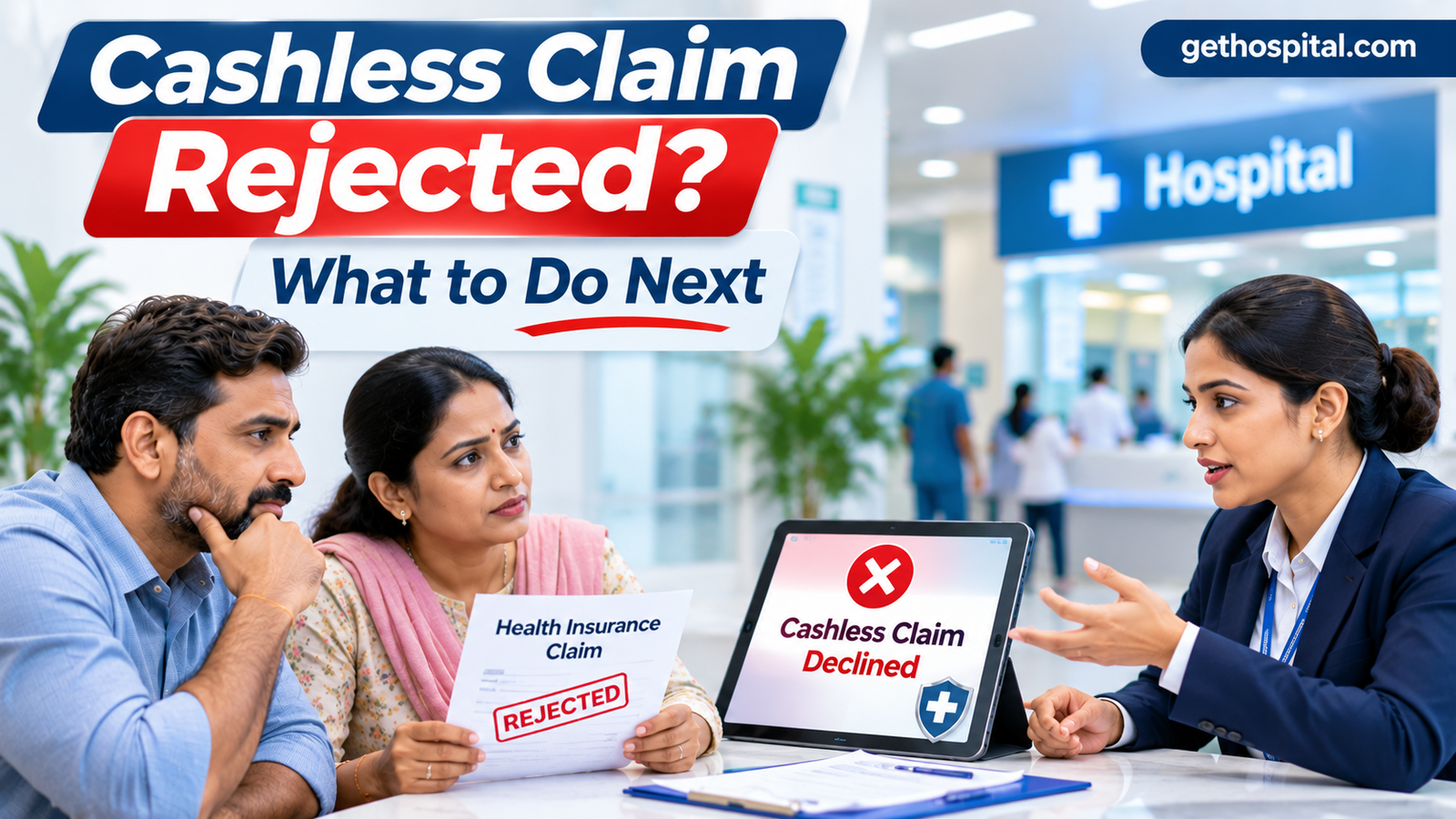
Then someone from the hospital’s insurance desk says, “Your cashless request has been rejected.”
Now what?
You may have a ₹5 lakh health insurance policy. You may have paid every premium on time. Still, the hospital is asking you to arrange money.
It’s a stressful situation, especially when treatment is already underway.
But here’s something important: a rejected cashless request does not always mean your entire health insurance claim has been permanently rejected.
Sometimes the problem is missing medical information. Sometimes it’s a hospital-network issue. And sometimes the treatment genuinely falls outside the policy’s coverage.
The next step depends on the actual reason.
In this guide, we’ll explain why cashless health insurance claims get rejected in India, what to do while you’re still at the hospital, how to request reconsideration, when reimbursement may be possible, and how to raise a complaint if the insurer’s decision appears unfair.
First, Understand What Has Actually Been Rejected
Before doing anything else, ask the hospital or insurance company one simple question:
“Has my cashless authorization been declined, or has my insurance claim been formally rejected?”
These are different situations.
Cashless authorization declined
This means the insurer has not agreed to settle the hospital expenses directly through the requested cashless arrangement.
Depending on the reason, you may be able to provide additional documents, request reconsideration or explore reimbursement.
Insurance claim repudiated
This means the insurer has formally rejected the claim based on its assessment of the policy and circumstances.
A formal rejection should explain the applicable policy terms and reasons.
Claim partially approved
Sometimes the insurer agrees to pay only part of the requested amount.
For example, the hospital may request authorization for ₹1,50,000, but the insurer approves ₹1,10,000.
That does not necessarily mean the remaining ₹40,000 is permanently excluded. The hospital may need to provide further details, or the balance may be subject to policy restrictions.
Don’t make a payment decision based only on someone saying “insurance rejected.” Get the actual status and reason.
What Should You Do Immediately If Cashless Insurance Is Rejected?
Let’s say you’re standing at the hospital billing counter and the insurer has declined the cashless request.
Here’s a practical way to handle it.
Step 1: Ask for the rejection reason in writing
Don’t rely only on a verbal explanation.
Request the insurer’s communication or claim-status details showing:
- Policy number
- Cashless request or claim reference number
- Date and time of the decision
- Specific reason for the decision
- Any policy clause relied upon
- Whether further documents or reconsideration are possible
If the hospital cannot provide the details, contact the insurer using its official helpline or application.
Step 2: Check whether documents are missing
Sometimes the insurer needs additional clinical information.
For example, the hospital may have submitted a surgery estimate but not included the doctor’s explanation of why hospitalization is medically necessary.
Ask the hospital insurance desk whether the insurer has raised a query.
If so, request the treating doctor or authorized hospital team to provide accurate supporting information.
Never ask anyone to change a diagnosis or create false records to obtain approval.
Step 3: Speak directly with the insurance company
Ask:
“Can you explain the exact reason for declining the cashless request, and is reconsideration possible if the hospital submits additional information?”
Record the complaint or call reference number.
Step 4: Request reconsideration if appropriate
If the decision appears to be based on incomplete or incorrect information, ask the insurer how to submit a reconsideration request.
Include the relevant medical documents and a clear explanation of the issue.
Step 5: Discuss payment arrangements with the hospital
If treatment cannot wait, ask for a written estimate, the immediate amount required and the available payment options.
Medical decisions should remain with the treating team. Do not delay emergency treatment solely because cashless authorization is pending.
Step 6: Ask whether reimbursement is possible
If cashless treatment cannot be arranged, ask the insurer whether the treatment can still be considered under the reimbursement process.
Get the submission requirements and applicable deadlines in writing.
Reimbursement is not guaranteed simply because cashless authorization was refused.
Common Reasons Cashless Health Insurance Gets Rejected
There isn’t one universal reason for rejection. Different policies have different coverage conditions.
Here are some situations worth checking.
1. The treatment is not covered
Suppose your policy excludes a particular procedure or category of treatment.
The insurer may decline expenses falling under that exclusion.
Check the policy wording and Customer Information Sheet rather than relying on a general statement from an agent.
2. A waiting period applies
Some health insurance policies have waiting periods for specified conditions or pre-existing diseases.
For example, suppose a policy includes a waiting period for a particular condition, and treatment takes place before that period ends.
The insurer may rely on the applicable waiting-period clause.
However, the exact condition, policy wording, applicable regulations and continuous coverage history matter.
3. The hospital has no applicable cashless arrangement
Let’s say you select a hospital because it appeared in an old insurer network list.
At admission, you discover that the cashless arrangement is unavailable for your insurer or policy.
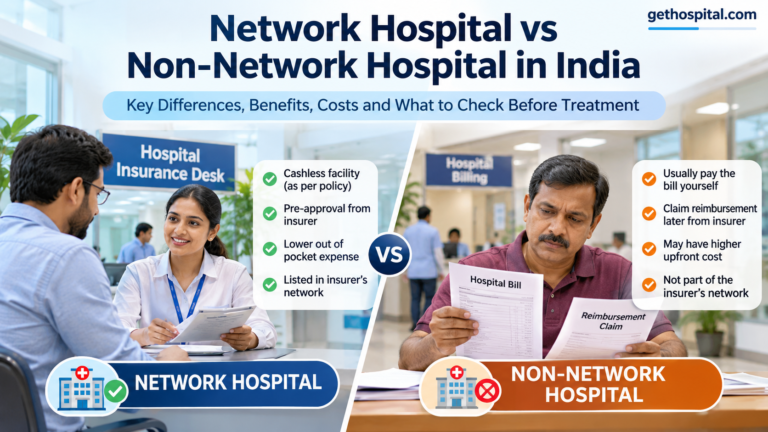
That may affect the cashless facility, but it does not automatically establish that the treatment itself is excluded from insurance coverage.
Ask whether a separate cashless arrangement is possible or whether reimbursement is the appropriate route.
4. The insurer needs more medical information
An insurer may request clarification about the diagnosis, treatment plan, admission necessity or expected expenses.
For example, the hospital may have submitted a short admission note without sufficient supporting information.
The correct response is to provide accurate documentation.
5. The policy has lapsed or coverage is unavailable
Check the policy’s status, renewal details, insured person’s name and available coverage.
Also verify whether the sum insured has already been used for previous claims.
6. The requested expense exceeds policy limits
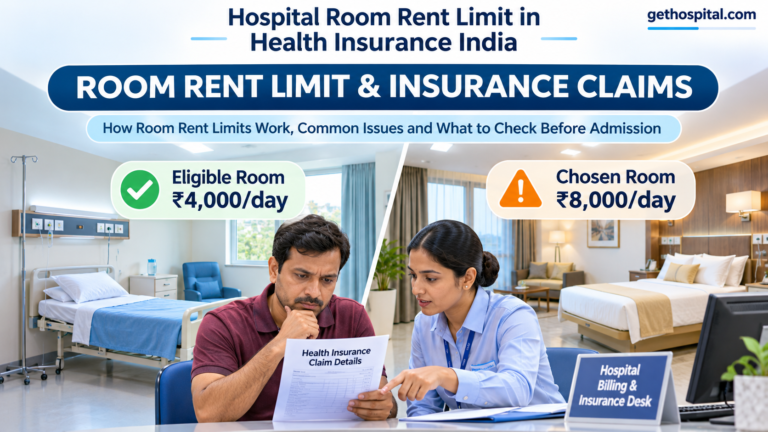
Room-rent restrictions, co-payments, deductibles and treatment-specific sub-limits can affect the approved amount.
A partial approval is not necessarily the same as a complete rejection.
7. There is a dispute about disclosure or policy conditions
An insurer may question information provided when the policy was purchased.
These disputes can be complicated.
For health insurance, IRDAI’s 2024 regulatory framework includes a 60-month moratorium after which a policy generally cannot be contested on grounds of non-disclosure or misrepresentation, except in cases of established fraud.
Continuous coverage and applicable portability or migration credits may matter.
If an insurer relies on non-disclosure, ask for the precise policy clause, evidence and explanation rather than assuming the decision is automatically valid.
Cashless Rejection vs Claim Rejection: Important Differences
| Situation | What it means | What you should check |
|---|---|---|
| Cashless request declined | Direct hospital settlement was not authorized | Reason, missing information, reconsideration or reimbursement |
| Claim under review | Insurer has not made a final decision | Pending queries and status |
| Partial authorization | Only part of the requested amount is approved | Deductions, limits and additional authorization |
| Formal claim repudiation | Insurer has rejected the insurance claim | Written reasons, policy clauses and grievance options |
| Reimbursement claim pending | Patient has submitted expenses for assessment | Documents, acknowledgement and applicable timeline |
The distinction matters because the solution for a missing pre-authorization document is very different from challenging a formal claim repudiation.
Can You Get Reimbursement After Cashless Rejection?
Sometimes, yes.
Let’s say you have an active health insurance policy, but the hospital cannot provide a cashless facility.
You pay the hospital bill and later submit the required documents to your insurer.
If the treatment is eligible under your policy, reimbursement may be available.
But suppose the insurer declined the request because the treatment is expressly excluded. Paying the hospital yourself will not automatically make that expense covered.
Before relying on reimbursement, ask the insurer to confirm the procedure and required documents.
Documents to keep for reimbursement
- Final itemized hospital bill
- Payment receipts
- Discharge summary
- Doctor’s prescriptions and treatment advice
- Diagnostic reports
- Pharmacy invoices, where applicable
- Claim form and insurer reference number
- Cashless rejection communication
- Other documents required under the policy
Keep digital copies and preserve originals where required.
Ask the insurer which documents must be submitted, how they should be submitted and what deadlines apply.
Example: Cashless Request Rejected Because of Missing Information
Imagine Priya has a family health insurance policy with ₹10 lakh coverage.
Her husband is admitted for a medically necessary procedure. The hospital submits a cashless request for ₹1.6 lakh.
The insurer asks for additional medical details.
The hospital insurance desk mistakenly tells Priya that the claim has been rejected.
Instead of assuming the policy is useless, Priya calls the insurer and learns that the request is awaiting a doctor’s clarification.
The hospital submits the missing information, and the insurer reviews the request again.
This is a hypothetical example. It does not mean every declined request can be approved after resubmission.
The lesson is simple: find out whether the insurer has made a final decision or is still seeking information.
What If the Hospital Demands the Full Bill?
This can be especially difficult when the patient is ready for discharge.
Ask the billing department for three things:
- A detailed final bill.
- The insurer’s written cashless decision or current status.
- A clear statement of what the hospital expects you to pay.
Suppose the bill is ₹2,40,000.
The insurer approves ₹1,90,000, and the hospital asks you to pay ₹50,000.
Don’t assume the difference is automatically correct or incorrect.
Request a breakdown showing non-covered items, co-payments, deductibles, sub-limits or other adjustments.
If the insurer has declined the entire cashless facility, ask whether reimbursement can be considered and what documentation you must retain.
For an unresolved dispute, use the insurer’s grievance process while keeping your medical and billing records.
What Does IRDAI Say About Cashless Claim Approval?
IRDAI’s health insurance framework includes important timelines.
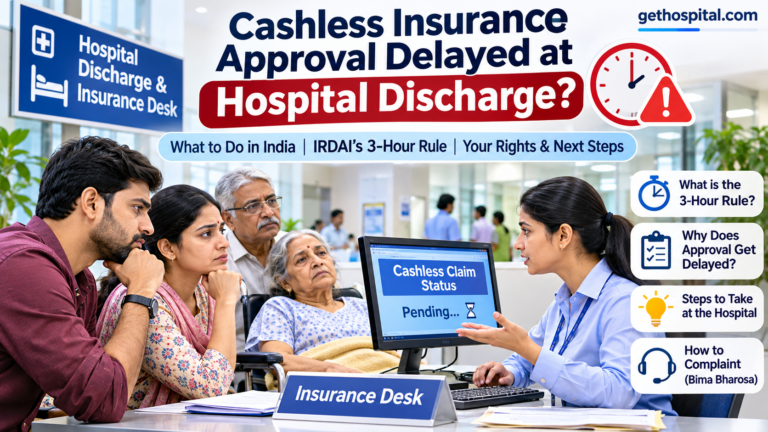
The 2024 regulatory circular requires insurers to decide cashless authorization requests within one hour of receiving them.
It also requires final discharge authorization within three hours of receiving the hospital’s discharge request.
If discharge authorization is delayed beyond three hours, the regulatory framework places responsibility on the insurer for additional hospital charges caused by that delay.
However, these timelines do not mean that every request must be approved regardless of policy coverage.
A timely rejection and an unfair rejection are different issues.
If you believe the insurer has wrongly declined an eligible claim, ask for the written decision and use the grievance process.
Can an Insurance Company Reject a Claim Without Explaining Why?
A formal claim rejection should not be a vague message saying only “claim not payable.”
IRDAI’s 2024 health insurance circular requires claim repudiation to be approved through the prescribed internal claims-review mechanism.
Where a claim is rejected or partially disallowed, the insurer must communicate the details, including references to the relevant policy terms and conditions.
If the explanation is unclear, ask for:
- The exact policy clause.
- The factual reason for applying it.
- The documents considered.
- The amount approved or disallowed.
- The grievance procedure.
This gives you something concrete to review and challenge if necessary.
How to Complain About a Rejected Health Insurance Claim
If you believe the insurer’s decision is incorrect, start with a written complaint.
Step 1: Contact the insurer’s Grievance Redressal Officer
Every insurer has a grievance mechanism.
Find the official grievance contact on the insurer’s website or through IRDAI’s published list.
Include your policy number, claim number, hospital name, treatment dates and a short explanation of why you disagree.
Attach the rejection letter and relevant documents.
Request a written acknowledgement.
Step 2: Escalate through IRDAI Bima Bharosa
If the insurer does not resolve the complaint within the applicable timeline, or you are dissatisfied with the response, you can approach IRDAI.
Official portal: https://bimabharosa.irdai.gov.in/
IRDAI helpline: 155255
Email: complaints@irdai.gov.in
Bima Bharosa allows policyholders to register and track complaints. The portal generates a reference or token number.
There is no fee for registering a complaint with IRDAI through this mechanism.
Step 3: Approach the Insurance Ombudsman when eligible
If your grievance remains unresolved or the insurer’s response is unsatisfactory, you may be able to approach the Insurance Ombudsman.
The Ombudsman provides a formal grievance-resolution route for eligible insurance disputes.
Official website: https://www.cioins.co.in/
Check the current eligibility requirements, monetary jurisdiction, filing deadline and procedural rules before submitting a complaint.
Sample Complaint Email for Cashless Claim Rejection
Subject: Request for Review of Rejected Cashless Health Insurance Claim
Dear Grievance Redressal Officer,
I am writing to request a review of the cashless health insurance decision relating to my hospitalization claim.
Policy Number: [Policy Number]
Claim Reference Number: [Claim Number]
Hospital Name: [Hospital Name]
Admission Date: [Date]
The hospital informed me that my cashless authorization request was declined. I request a written explanation of the decision, including the specific policy terms and supporting reasons.
I also request confirmation of whether additional medical documents, reconsideration or reimbursement are available under my policy.
I have attached the relevant documents for your review.
Please acknowledge this complaint and provide a written response.
Regards,
[Policyholder Name]
[Registered Contact Details]
Can You Challenge a Claim Rejection Based on a Pre-Existing Disease?
You can challenge the decision if you believe the insurer has incorrectly applied the policy terms or regulations.
For example, suppose an insurer says a claim is excluded because of a pre-existing condition.
Check:
- How the policy defines that condition.
- The applicable waiting period.
- The start date of continuous coverage.
- Any portability or migration benefits.
- The insurer’s exact reason for rejection.
- Whether the moratorium provisions are relevant.
A pre-existing disease does not automatically mean that every related or unrelated hospitalization can be rejected.
Similarly, the existence of a moratorium does not mean that every claim must be paid. Other valid policy conditions may still apply.
If the dispute involves substantial expenses, consider obtaining independent professional advice.
What If Your Employer Provides the Health Insurance?
Employer-sponsored group health insurance can have different arrangements from an individual policy.
Contact your company’s HR or employee benefits team.
Ask for the insurer’s claims contact, group policy details and the relevant escalation process.
However, don’t assume that HR can override the insurer’s coverage decision.
Request the applicable policy terms and written reasons for any refusal.
Five Mistakes People Make After Cashless Claim Rejection
1. Accepting a verbal rejection without checking
Always request the actual decision and reason.
2. Paying without keeping records
If payment becomes necessary, preserve bills, receipts and insurer communications.
3. Assuming reimbursement is guaranteed
Reimbursement still depends on the policy.
4. Complaining without identifying the issue
A complaint explaining the specific policy clause or factual mistake is more useful than simply saying the insurer is unfair.
5. Sharing personal documents with unofficial intermediaries
Use official insurer, hospital and regulatory channels. Never share OTPs, banking passwords or login credentials.
How to Reduce the Risk of Cashless Problems Before Admission
You cannot prevent every claim dispute, but you can prepare better.
For planned treatment, verify the hospital’s current cashless arrangement with your insurer.
Read the Customer Information Sheet and check waiting periods, exclusions, room eligibility and co-payment conditions.
Ask the hospital for a written treatment estimate.
Inform the insurer as required and keep the pre-authorization reference number.
For emergency admissions, focus on medical care first and arrange claim communication as soon as reasonably possible.
Frequently Asked Questions
1. What should I do if my cashless health insurance is rejected?
Ask for the written reason, check whether additional information is required, contact the insurer and explore reconsideration or reimbursement where applicable.
2. Does cashless rejection mean my insurance policy is useless?
No. A cashless refusal may relate to the settlement arrangement or authorization request rather than a final decision on all coverage.
3. Can I apply for reimbursement after cashless rejection?
You may be able to, depending on the reason for refusal and your policy’s terms.
4. Can an insurer reject a claim because the hospital is not in its network?
An unavailable cashless arrangement may prevent direct settlement, but reimbursement eligibility should be assessed separately under the policy.
5. What if the hospital submitted incomplete documents?
Ask the hospital to provide accurate missing information and confirm whether the insurer will reconsider the request.
6. Can I complain to IRDAI about a rejected claim?
Yes. Start with the insurer’s grievance process and escalate through IRDAI’s official channels if unresolved or unsatisfactory.
7. Is Bima Bharosa free?
Yes. IRDAI does not charge policyholders to register complaints through Bima Bharosa.
8. How long should an insurer take to decide a cashless request?
IRDAI’s 2024 framework specifies a decision within one hour of receiving the request.
9. Does the one-hour rule guarantee approval?
No. It concerns the decision timeline, not unconditional coverage.
10. Can a health insurance claim be rejected for a pre-existing disease?
It depends on the policy, waiting periods, continuous coverage, regulatory protections and the specific circumstances.
11. What if the insurer approves only part of my hospital bill?
Request an itemized explanation of the deductions and the relevant policy clauses.
12. Can I approach the Insurance Ombudsman?
Yes, if the dispute meets the Ombudsman’s eligibility, jurisdiction and procedural requirements.
13. What if my employer’s group insurance cashless request is rejected?
Contact the insurer and your employer’s HR or benefits team, and request the applicable group policy terms.
14. Is a hospital deposit refundable after insurance approval?
It depends on the hospital’s billing arrangements and the final approved settlement. Ask for written adjustment or refund details.
15. Can I challenge a wrong claim rejection?
Yes. You can request reconsideration, submit a grievance and use applicable external dispute-resolution channels.
16. Should I stop treatment if cashless approval is rejected?
Do not make treatment decisions solely on insurance status. Discuss medical urgency and options with the treating team.
17. What documents are most important when challenging rejection?
Keep the policy, rejection communication, claim reference, medical records, hospital bills and all relevant correspondence.
18. Does having ₹10 lakh insurance guarantee a ₹10 lakh hospital payment?
No. Payment depends on eligible expenses, available coverage, policy limits and applicable conditions.
Final Thoughts
A rejected cashless request can feel frightening when someone in your family is already in hospital.
But before assuming that the insurance company will pay nothing, find out what has actually happened.
Was the request declined because of missing documents? Is the hospital outside the cashless arrangement? Has the insurer formally rejected the claim under a specific policy clause?
The answer determines your next step.
Get the decision in writing, preserve your documents, ask for reconsideration where appropriate and use the official grievance process if the issue remains unresolved.
Most importantly, don’t let insurance paperwork distract you from necessary medical care.
Official Sources and Further Reading
- IRDAI – Insurance Regulatory and Development Authority of India
- Bima Bharosa – Official Insurance Grievance Portal
- Bima Bharosa – Frequently Asked Questions
- Council for Insurance Ombudsmen
- Ministry of Finance – Government of India
Disclaimer: This article provides general information about health insurance in India. It is not legal, medical or individualized insurance advice. Claim decisions depend on the policy, facts and applicable regulations. Verify current requirements with your insurer and relevant authorities before making financial or medical decisions.