Imagine your father needs surgery. The doctor recommends a hospital, and you have a health insurance policy with ₹5 lakh coverage.
You call the hospital and ask whether cashless insurance is available. The billing desk says, “We accept health insurance, but please check with your insurance company.”
Now you’re confused. If the hospital accepts insurance, why do you still need confirmation? And what happens if the hospital isn’t on your insurer’s network list?
This is where understanding the difference between a network hospital and a non-network hospital becomes important.
The difference can affect how you pay your hospital bill, how your claim is processed and how much money you may need to arrange during treatment.
Let’s understand it with practical examples.
What Is a Network Hospital?
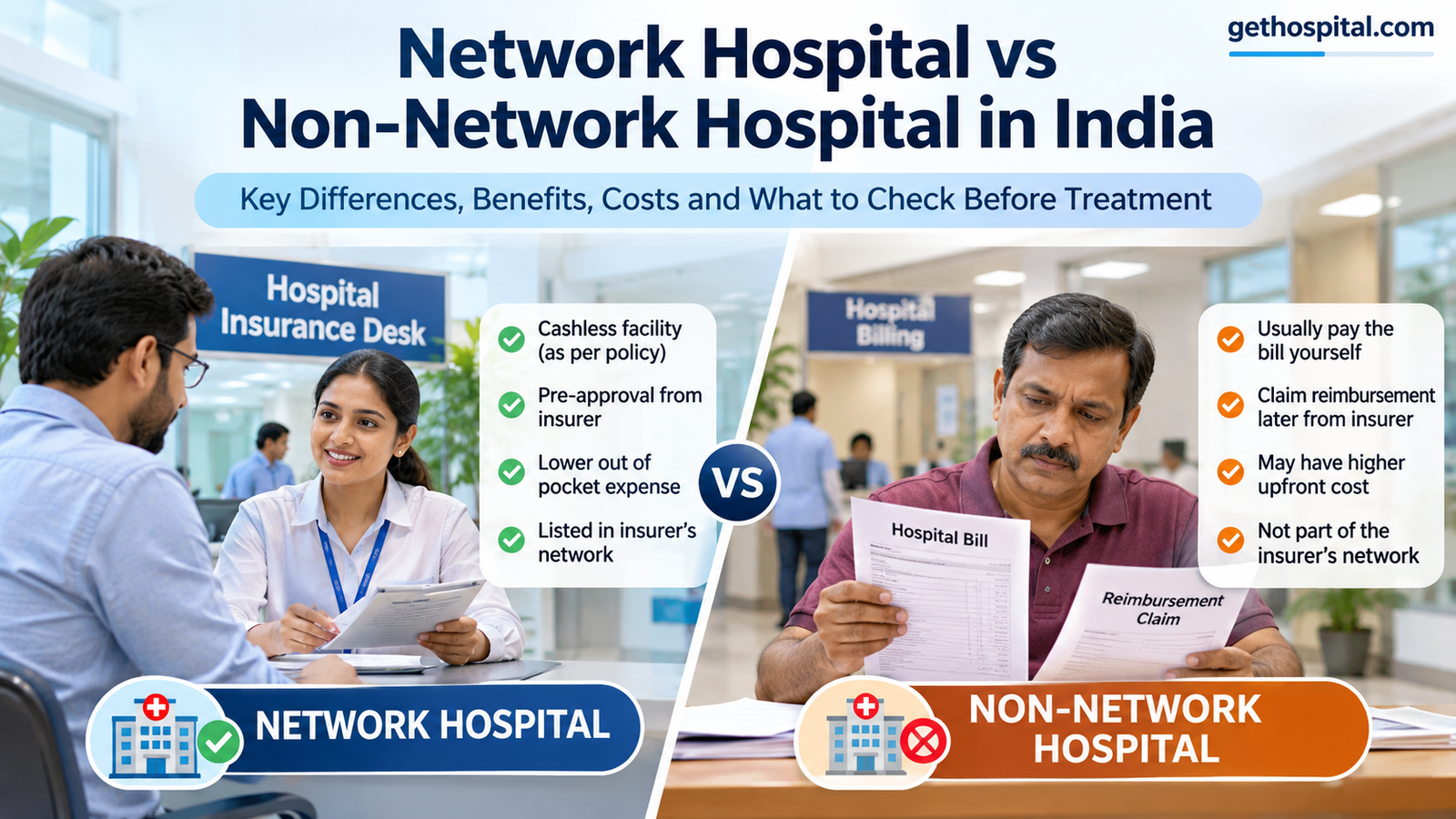
A network hospital is a hospital that has an arrangement with your health insurance company, directly or through an authorized third-party administrator (TPA), to provide cashless treatment to eligible policyholders.
Suppose you have a health insurance policy from Insurer A.
Insurer A has a cashless arrangement with Hospital X. If your policy covers the treatment and your cashless request is approved, the insurer can settle the eligible hospital expenses directly with Hospital X.
You generally pay only the amounts that are not covered under your policy.
These may include:
- Non-payable items under your policy
- Applicable co-payments or deductibles
- Expenses above policy limits or sub-limits
- Charges related to excluded treatment
- Any difference between the eligible claim amount and the final hospital bill
Important: A network hospital does not mean every treatment is automatically covered or that your entire bill will be paid.
What Is a Non-Network Hospital?
A non-network hospital is a hospital that is not included in your insurer’s applicable cashless hospital network.
You may still be able to receive treatment there.
However, under the usual reimbursement process, you pay the hospital expenses first and then submit a claim to your insurer.
For example, suppose your mother is admitted to Hospital Y, which is not part of your insurance network.
The final hospital bill is ₹1,20,000.
You may have to pay that amount to the hospital before discharge. Afterward, you submit the claim form, hospital bills, discharge summary and other required documents.
The insurer then evaluates the claim under your policy terms.
It may reimburse the full eligible amount, a smaller amount or nothing if the treatment is not covered.
Can a non-network hospital provide cashless treatment?
Sometimes, yes.
Some insurers offer cashless arrangements at eligible non-network hospitals through special initiatives or case-specific arrangements.
But this facility is not automatic or guaranteed at every hospital.
The insurer and hospital must be able to arrange the cashless process, and the treatment must satisfy the policy conditions.
Before admission, ask your insurer whether cashless treatment can be arranged at that particular hospital.
Do not rely only on a general advertisement saying “cashless everywhere.”
Network Hospital vs Non-Network Hospital: Main Differences
| Feature | Network Hospital | Non-Network Hospital |
|---|---|---|
| Hospital arrangement | Included in the insurer’s applicable network | Not included in that network |
| Cashless treatment | Generally available for eligible, approved claims | May be available through special arrangements; otherwise reimbursement |
| Initial payment | Usually only deposit or uncovered amounts, depending on the hospital and approval | Often requires payment of the hospital bill upfront |
| Claim handling | Hospital coordinates the cashless request with the insurer or TPA | Patient usually submits a reimbursement claim |
| Documents | Hospital generally helps submit cashless documents | Patient should collect and retain claim documents |
| Final insurance payment | Based on policy terms and approved claim | Based on policy terms and claim assessment |
| Financial preparation | Usually lower upfront cash requirement after approval | May require substantially more money upfront |
The most important difference for many families is when they need to arrange the money.
A Simple Example: Two Hospitals, Same Surgery
Let’s say two patients need the same type of surgery.
Both have policies with a ₹5 lakh sum insured, and each receives a hospital bill of ₹1,50,000.
Patient A: Network Hospital
The patient is admitted to a network hospital.
The insurer approves ₹1,25,000 under the applicable policy terms.
The hospital settles that approved amount through the cashless process.
The patient pays the remaining ₹25,000.
Patient B: Non-Network Hospital
The second patient receives treatment at a hospital where cashless settlement is unavailable.
The patient pays ₹1,50,000 to the hospital.
After reviewing the reimbursement claim, the insurer approves ₹1,25,000.
The patient ultimately bears ₹25,000, but had to arrange the entire ₹1,50,000 initially.
These figures are hypothetical and only illustrate the payment process.
In real cases, the approved amounts may differ because of hospital charges, policy limits, medical necessity, exclusions and other conditions.
The lesson: Two claims can have similar final insurance benefits but very different upfront payment requirements.
How to Check Whether a Hospital Is in Your Insurance Network
Don’t assume that a hospital is covered just because its website displays your insurer’s logo.
Hospital networks change, and arrangements may differ by insurance product or TPA.
Follow these steps before planned admission.
Step 1: Open Your Insurer’s Official Website
Look for a section such as:
- Network Hospitals
- Cashless Hospitals
- Hospital Locator
- Hospital Search
Enter your city and hospital name.
Step 2: Check Your Exact Policy
A hospital appearing in a general insurer directory may not automatically confirm eligibility under every insurance arrangement.
Check your policy type, insurer and TPA details.
Step 3: Call the Hospital’s Insurance Desk
Ask:
“Is cashless treatment currently available for my insurance company and policy?”
Also ask whether the hospital can submit the pre-authorization request.
Step 4: Confirm With Your Insurer
Contact the insurer through its official helpline, app or email.
Give the hospital’s full name, branch and location.
Ask for written confirmation where possible.
Step 5: Check Your Policy Coverage
Even after confirming network status, verify:
- Whether the proposed treatment is covered
- Whether a waiting period applies
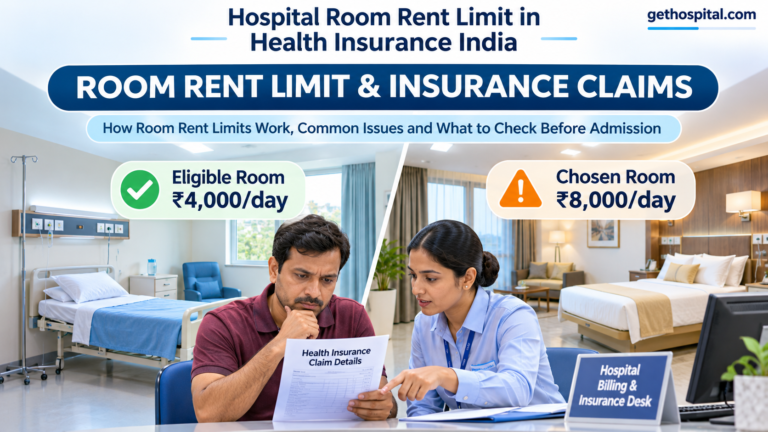
- Whether there is a room-rent limit
- Whether co-payment or a deductible applies
- Whether the policy has a disease-specific sub-limit
- Whether the hospital is excluded or restricted under your policy
Practical tip: Save the hospital network search result and any written confirmation. They may help if there is confusion during admission.
What Happens During Cashless Treatment at a Network Hospital?
The process usually looks like this.
1. Hospital Admission
You visit the hospital’s insurance desk and provide your policy information and relevant identification.
For planned treatment, contact the hospital and insurer before admission whenever possible.
2. Pre-Authorization Request
The hospital sends the proposed treatment details and estimated expenses to the insurer or TPA.
This is called a pre-authorization request.
3. Insurance Review
The insurer checks the request against the policy terms and available medical information.
It may approve the request, ask for clarification or decline cashless authorization.
4. Treatment and Billing
Once the cashless arrangement is approved, the hospital coordinates eligible billing with the insurer.
You should still ask about expenses that may remain payable by you.
5. Final Authorization and Discharge
The hospital sends the final bill and relevant discharge documents for authorization.
The insurer assesses the eligible amount, and the hospital informs you of any remaining payment.
For a detailed explanation, read our guide on Cashless Health Insurance in India, available in the Health Insurance section.
What If a Network Hospital Refuses Cashless Treatment?
First, find out exactly what has been refused.
There is a difference between:
- The hospital not accepting cashless requests for your insurer
- The hospital being temporarily unable to process a request
- The insurer declining pre-authorization
- The insurer asking for additional documents
- The treatment being excluded under your policy
Ask the hospital insurance desk for the specific reason.
Then contact your insurer and confirm whether the hospital is currently part of its applicable network.
If the insurer has declined the request, ask for the written reason and the relevant policy clause.
Do not assume that a cashless denial automatically means your reimbursement claim will also be rejected.
Where appropriate, you may ask about reconsideration or reimbursement.
Our Health Insurance guides also explain what to do when a cashless claim is rejected.
How Does Reimbursement Work at a Non-Network Hospital?
Suppose your family chooses a hospital that does not have a cashless arrangement with your insurer.
The reimbursement process generally involves the following steps.
Step 1: Inform Your Insurer
Notify the insurer about hospitalization as soon as reasonably possible, using an accepted channel.
Follow the policy’s claim-intimation procedure. If you could not notify the insurer promptly, explain the circumstances.
Step 2: Pay the Hospital Bill
Where cashless settlement is unavailable, you may need to settle the bill directly with the hospital.
Request an itemized final bill and payment receipts.
Step 3: Collect Your Documents
Depending on the claim, you may need:
- Completed claim form
- Discharge summary
- Final hospital bill and detailed bill breakup
- Payment receipts
- Doctor’s prescriptions and relevant treatment records
- Investigation reports
- Pharmacy bills, where applicable
- Policy and identity details
- Bank account information for reimbursement
The insurer may request other relevant information according to its process.
Step 4: Submit the Claim
Use your insurer’s official claim portal, app, email or other accepted submission channel.
Check the applicable claim-submission requirements and keep proof of submission.
Step 5: Track the Decision
The insurer evaluates the claim under the policy.
If the approved amount is lower than expected, request a detailed explanation of deductions.
Do not discard your hospital documents until the claim and any related dispute are resolved.
Does Treatment at a Non-Network Hospital Cost More?
Not necessarily.
A non-network hospital may charge less or more than a network hospital.
Network status mainly tells you about the insurer’s payment arrangement, not whether a hospital is cheaper or provides better medical care.
For example, a smaller non-network hospital may quote a lower treatment package than a large network hospital.
But the smaller hospital may still require full payment upfront.
Meanwhile, the network hospital may offer cashless settlement but have higher total charges or certain uncovered expenses.
This is why you should compare:
- Whether the hospital can provide the required medical care
- The estimated total treatment cost
- The insurance coverage available
- The amount you may need to pay upfront
- The possible final out-of-pocket expense
Choose a hospital based on appropriate medical care, affordability and practical access—not network status alone.
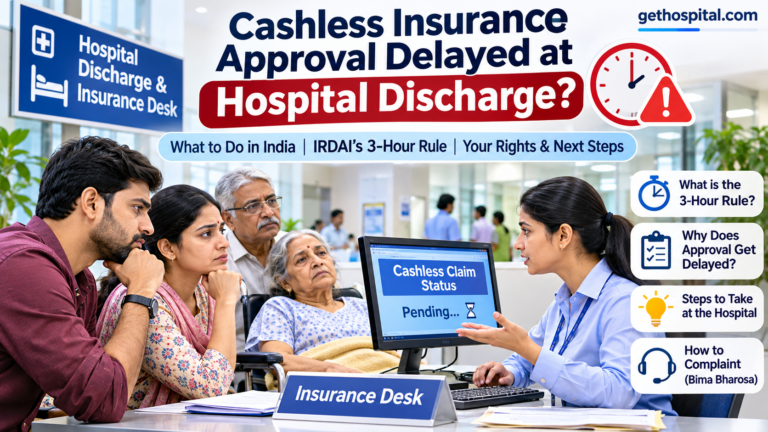
What Are the IRDAI Rules for Cashless Claim Authorization?
India’s insurance regulator, the Insurance Regulatory and Development Authority of India (IRDAI), issued a Master Circular on Health Insurance Business in May 2024.
The circular states that insurers must decide cashless authorization requests within one hour of receiving them.
It also specifies that final authorization for discharge must be provided within three hours of receiving the hospital’s discharge authorization request.
If an insurer delays final authorization beyond the prescribed period, the circular addresses responsibility for additional hospital charges resulting from that delay.
These requirements concern claim processing. They do not mean that every treatment must be approved or that every hospital must automatically offer cashless treatment.
If you face a delay, record when the hospital submitted the request and contact the insurer’s grievance team.
For regulatory information, visit the IRDAI official website.
What Should You Check Before Choosing a Hospital?
Here is a practical checklist you can use before planned hospitalization.
| Question | Why It Matters |
|---|---|
| Is the hospital suitable for the required treatment? | Medical capability and safety come first |
| Is it currently in my insurer’s network? | Helps establish the usual cashless process |
| Is cashless available under my exact policy? | Network status alone may not be enough |
| Is the proposed treatment covered? | Avoids assuming all procedures are insured |
| What is the estimated total bill? | Helps you plan your finances |
| Are there room-rent or treatment limits? | May affect the approved claim |
| How much money may I need to arrange? | Important even with cashless insurance |
| Who handles insurance authorization? | Identifies the hospital contact |
| What happens if cashless approval is declined? | Helps you prepare a reimbursement plan |
You can save this checklist on your phone before speaking to the hospital’s insurance desk.
What About Emergency Hospitalization?
In an emergency, getting appropriate medical attention is the priority.
Do not delay urgent treatment simply to search for a network hospital.
Once the patient is receiving care, a family member can contact the insurer and hospital billing desk to understand the available claim process.
If the hospital is non-network, ask whether a cashless arrangement can be made. Otherwise, prepare for the reimbursement process if the policy permits it.
Keep the admission records, bills and medical documents safely.
Common Mistakes Patients Make
Assuming Every Network Hospital Guarantees Cashless Approval
The hospital may be in the network, but the treatment must still satisfy policy conditions.
Choosing a Hospital Based Only on Its Insurance Logo
An old logo or outdated hospital list may not reflect the current arrangement.
Ignoring Room-Rent Limits
Some policies restrict eligible room categories or impose limits that affect the claim.
Forgetting About Non-Payable Expenses
Cashless insurance does not necessarily cover every item on a hospital bill.
Not Asking for Written Reasons
If an authorization is denied or deductions appear, request the reason in writing.
Losing Bills After Reimbursement Submission
Keep copies of all important documents and correspondence.
Frequently Asked Questions
1. Is a network hospital always cashless?
No. Cashless treatment is subject to policy coverage, eligibility, authorization and the hospital’s current arrangement with the insurer.
2. Can I use health insurance at a non-network hospital?
Often, yes, through reimbursement, provided the treatment and hospital satisfy your policy requirements. Some insurers may also arrange cashless treatment at certain non-network hospitals.
3. Is reimbursement guaranteed at a non-network hospital?
No. Reimbursement depends on policy terms, coverage, exclusions, claim assessment and applicable requirements.
4. Can I choose any hospital in India?
You can choose where to seek treatment, but insurance payment is subject to your policy. Check whether the hospital meets the insurer’s requirements and whether cashless or reimbursement is available.
5. What if my preferred hospital is not in the network?
Ask the insurer whether a special cashless arrangement is possible. If not, check reimbursement eligibility and the likely upfront payment.
6. Can a network hospital ask for a deposit?
Yes, depending on the circumstances and hospital practices. Ask why the deposit is required and how it will be adjusted or refunded after insurance settlement.
7. Does a network hospital charge less?
Not necessarily. Hospital pricing and network status are different matters.
8. Is a non-network hospital less reliable?
No. Network status does not, by itself, establish the quality or safety of a hospital.
9. Can cashless approval be denied even at a network hospital?
Yes. For example, a request may be declined because of a policy exclusion, waiting period, insufficient information or another applicable policy condition.
10. What if my insurer removes a hospital from its network?
Contact the insurer to confirm the current status and ask about available alternatives. Do not assume an earlier listing remains valid.
11. Do all insurance companies have the same hospital network?
No. Each insurer may have different hospital arrangements, and these can change.
12. Is the hospital network the same for employer-provided insurance?
Not always. Check the exact group policy and its applicable insurer or TPA arrangements.
13. What is a TPA in health insurance?
A Third Party Administrator is an entity that provides specified health insurance administration services on behalf of an insurer. Its role may include coordinating cashless requests and claims.
14. Can I switch hospitals if cashless treatment is unavailable?
For planned treatment, you can explore another suitable hospital after discussing medical considerations with your treating doctor. For emergencies, prioritize timely medical care.
15. What if the hospital says the insurer has not responded?
Ask when the request was submitted, obtain the reference number and contact the insurer directly. Keep records of the communication.
16. Does cashless insurance mean I pay nothing?
No. Co-payments, deductibles, exclusions, non-payable items and policy limits may leave some expenses payable by you.
17. What if my reimbursement amount is lower than the bill?
Ask the insurer for an itemized explanation showing approved expenses, deductions and relevant policy terms.
18. Where can I complain about an insurance claim problem?
Start with the insurer’s grievance redressal process. If the issue remains unresolved, you can use the applicable regulatory grievance channels, including Bima Bharosa, and consider the Insurance Ombudsman where eligible.
Final Thoughts
A network hospital can make the payment process easier because eligible cashless expenses may be settled directly between the hospital and insurer.
A non-network hospital may still be a suitable treatment option, but you might need to arrange the money first and claim reimbursement later.
Neither option automatically guarantees full insurance coverage.
Before planned admission, check the hospital’s medical suitability, current network status, your policy benefits and the amount you may need to pay.
A few questions before admission can prevent a lot of confusion at discharge.
Medical and Insurance Disclaimer: This article provides general educational information for readers in India. It is not medical, legal or personalized insurance advice. Policy terms, hospital arrangements and claim procedures vary. Confirm current details with your insurer, hospital and relevant official authorities.